China – South to North. Mohan to Erinhot. May 3rd to May 19th
3rd May – Pu’er
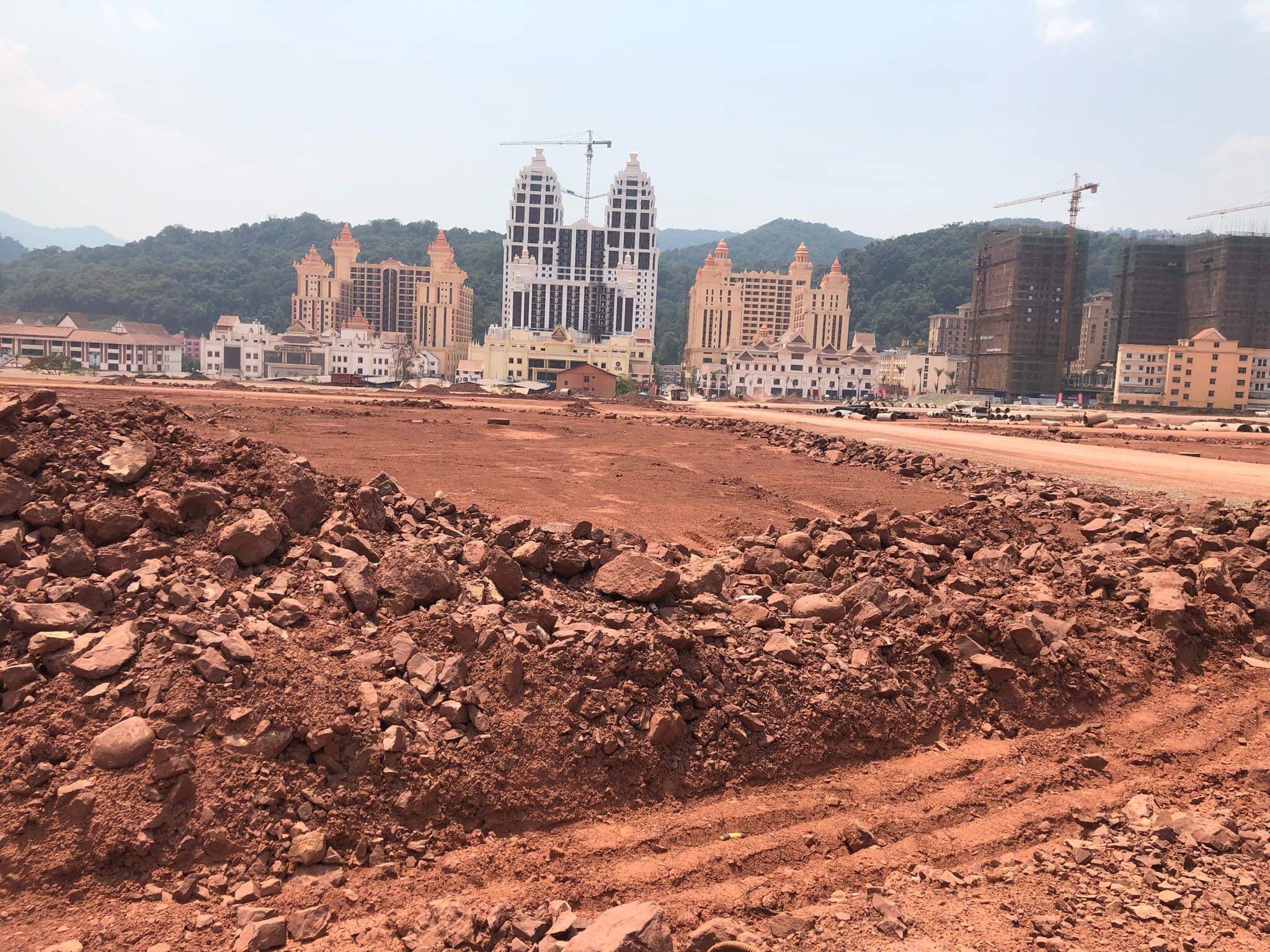
Having experienced the bizarre world of Boten, and its red dust and ‘hospitality’!

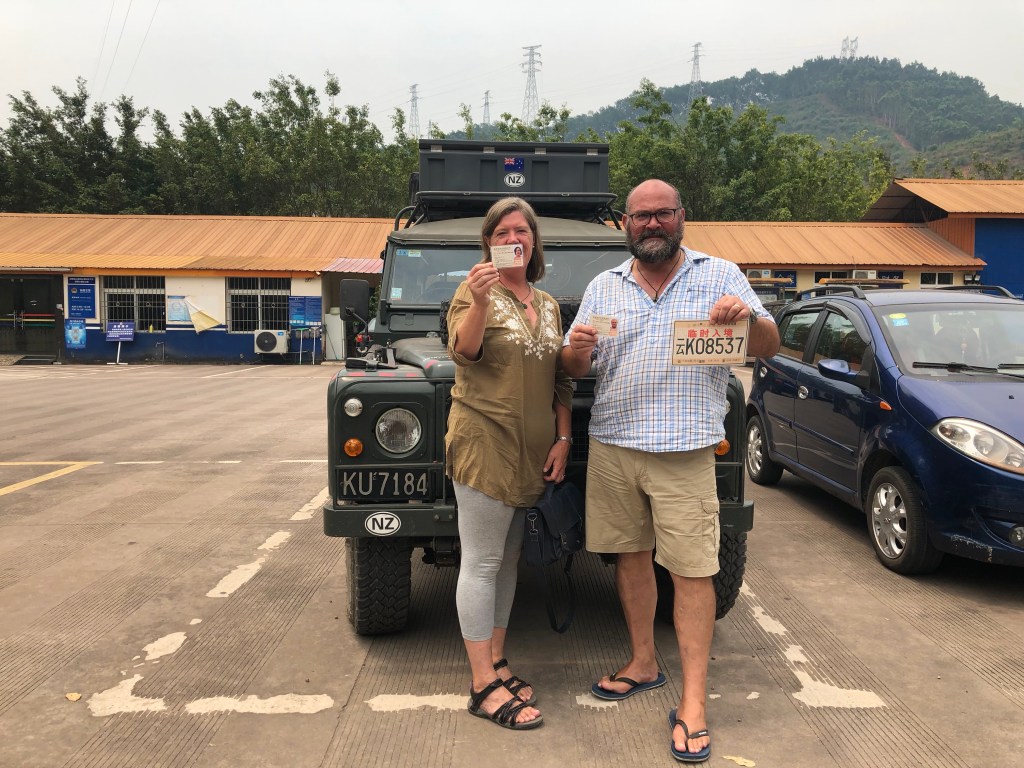
We pass into China via Mohan, with the help of our guide Yingchu Zhao. Who has organised all the necessary paper work. (The departure from Laos and the entrance to China is detailed in a previous entry.) We are pleasantly surprised by the greenness of China and how clean and tidy it is.
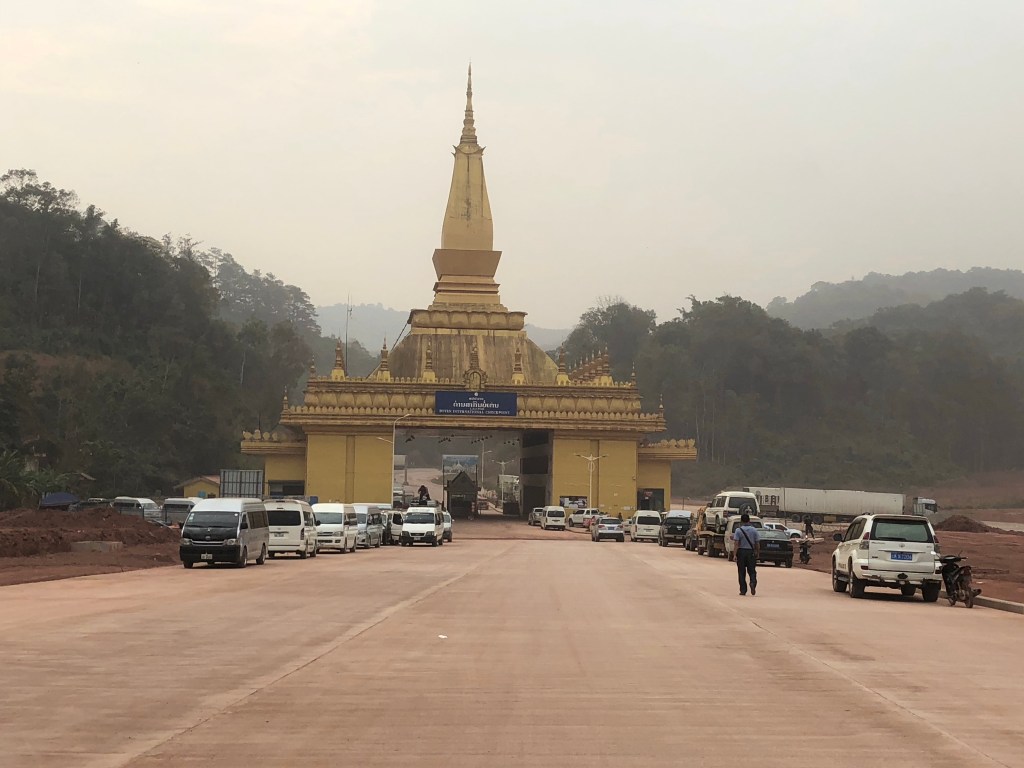
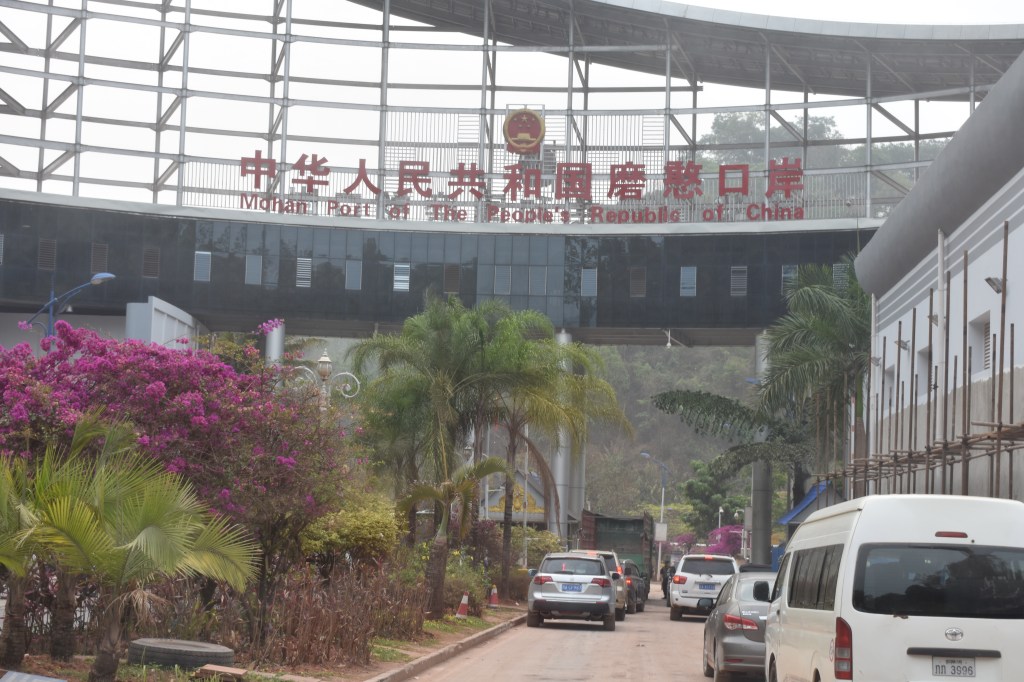
We are pleased to have passed the vehicle inspection test that gives Fred the right to be on the road in China. And received our own licenses etc. Fred is unique and derives a great deal of interest.

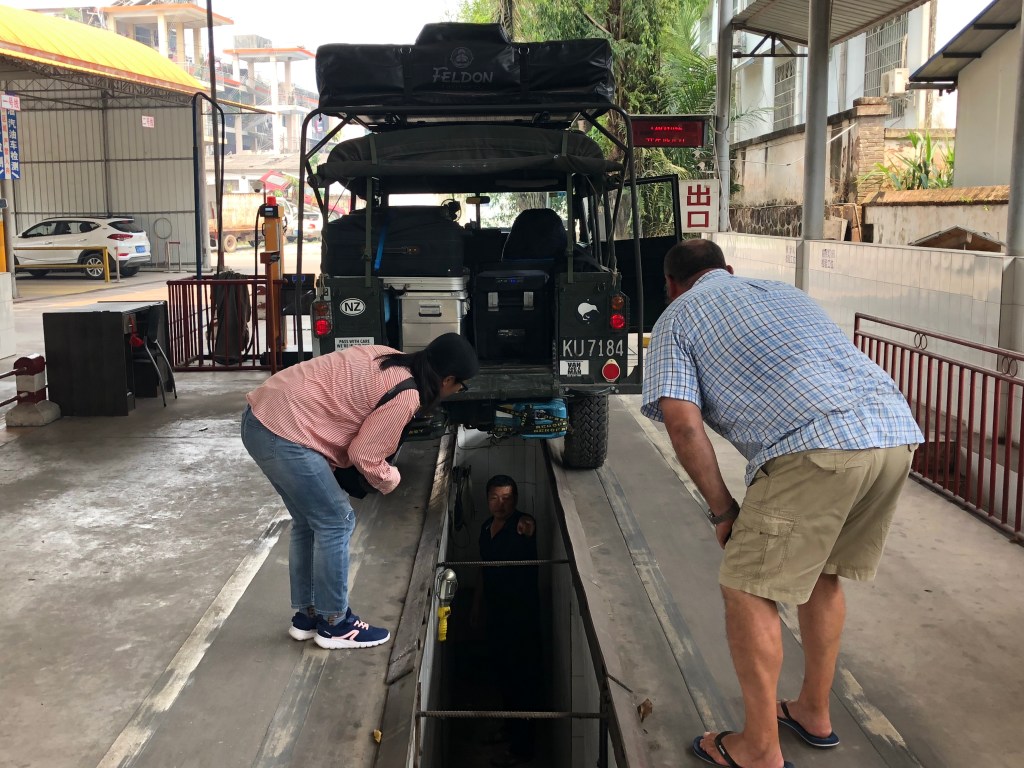
Good to go! We have done all of this in good time. So much so that we will have time up our sleeves later in the day. Our plan was to drive to Jinghong that day and then on to Pu’er the following day. However we end up getting to Pu’er that evening. The drive was along good roads, lined with rich and productive land. Tea plantations, rice paddies, and general, what I would call, market garden produce. It really gives us the impression that they are prosperous and not at all oppressed?
At the Hotel in Pu’er we park, but have to re park because the man who takes his Job very seriously, wants me to move over so that he can accommodate other cars. In doing so, as I put Fred into reverse, the gear stick comes away in my hand? The silence is deafening! Except in my head……..which I won’t repeat! Neither of us speak. Yingchu to her credit defuses the situation by saying, “Julia and I will check in whilst Kieran deals with the issue”?
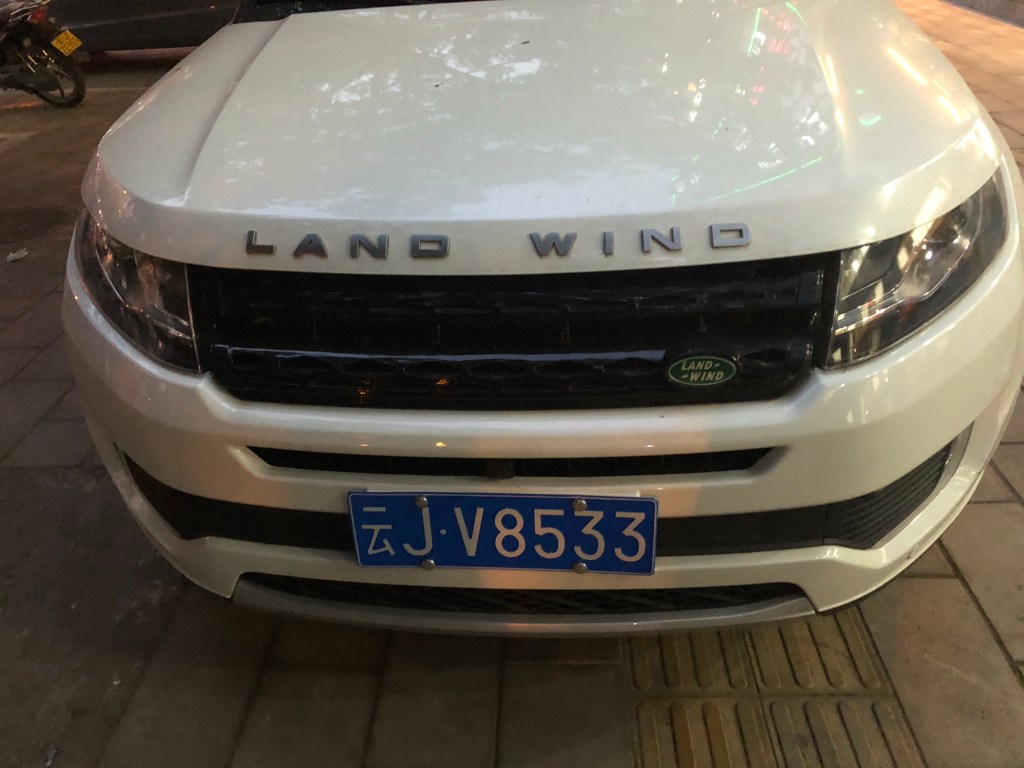
I quickly realise that it hasn’t just come out of the gear box but has snapped off as close to the gates as it could have! On closer inspection it looks like it has started to shear over a long period and was only a matter of time til it did what it did! Yingchu gets on the phone and within what seems only minutes two scruffy looking guys on a scooter arrive. He confirms my thoughts that it’s stuffed! Haha! But, can be fixed by a simple welding job. So in the dark and with only the lamp we had, (a gift from Brendan Maguire for Julia’s 50th Birthday) they dismantle the gear selector box and take away the stick. Promising to return in a couple of hours or so. Which they duly do. In the mean time we have had time to change and have some supper. Local Chinese food, which is delicious, a beer also makes my worries a bit better. The streets were bustling with day to day busyness and the smells of the food and shops drew our eyes from side to side. It was then that we saw the first of of the famous Chinese knockoffs……a “Land Wind” which doesn’t quite have the same ring about it?
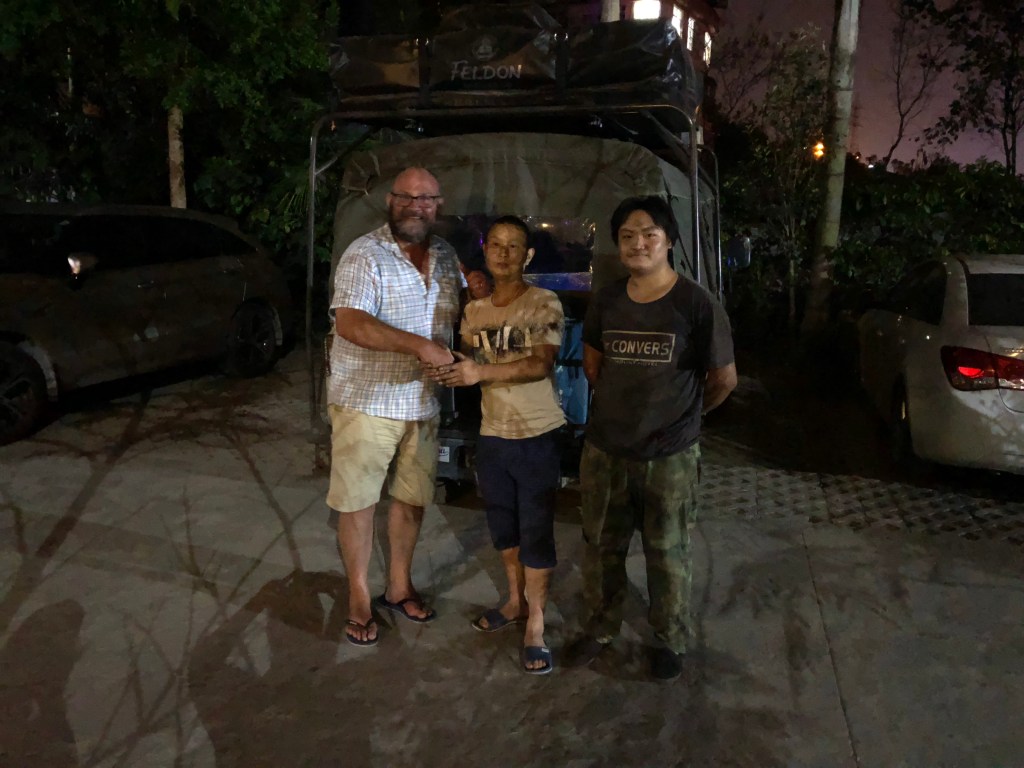
They replace the stick with pride and get me to check it. As I jump into the drivers seat it is clear he realises what he’s done! He has welded it back into a left hand drive position! I am not in a space to care as long as it works, so nod and give him the thumbs up. He is pleased that it is fixed but disappointed in himself for making the basic simple error. We ask how much and are surprised when he says 1000 Yuan. This is not much in fact it is only nz$50 and he refuses to take a tip, which we feel he has earned as it is after hours and late. He tells us that he is open 24/7 . This is how he makes money. A good work ethic and attitude. We give him a Kiwi pen and key ring which other than cash is the only other way we can thank him. He is pleased and leaves with his ‘side-kick’ on their scooter.
A very short drive to Xi’an where after checking in we walk to the Metro which is clean and on efficiently on time. Undergound to the museum where they have a vast collection of artifacts dating back to the 500 and 600’s. Bronzes, pottery and ancient currencies etc. Each day the museum gives away 3000 free tickets. we miss out the place is packed. Xi’an is a small city of only 10,000,000! Ying Chu walks so we walk too! The city has history as most places we visit do. In the centre are two large pagodas or towers, and more beautifully landscaped public areas, full of ‘newish’ sculptures depicting monks, poets and other famous Chinese characters. Of the two pagodas on the city walls one is a bell tower that rings in the beginning of each day. The other is a drum tower. this has 24 large drums and several massive drums. These are hit at the end of the day. They are also played in a particular sequence depending upon what season it is. The sequence allow the people to know what they should be planting or harvesting at that particular time. As we walk we wander down narrow and old streets and alleyways dedicated to food and produce of all kinds. Sheep hooves, mutton, fruit and spices of all types. It is what is known as the Muslim area. Again we are getting mixed messages about how the Muslim community are treated by the Chinese government. As we get closer to the hotel Ying Chu gets another call. They are worried about Fred and the curious people who think its ok to just open the doors and sit in the car? They have saved us a spot closer along the street towards the hotel for better security.
Pu’er is named after the tea that the region produces, not the other way round. It took the name in 1729, but was changed in 1950 to Simao by the communist regime after victory in the Chinese Civil War. The name was then changed back to Pu’er in 2007. As I said a small provincial city of only 2.5 million people.
4th May – Yunxian
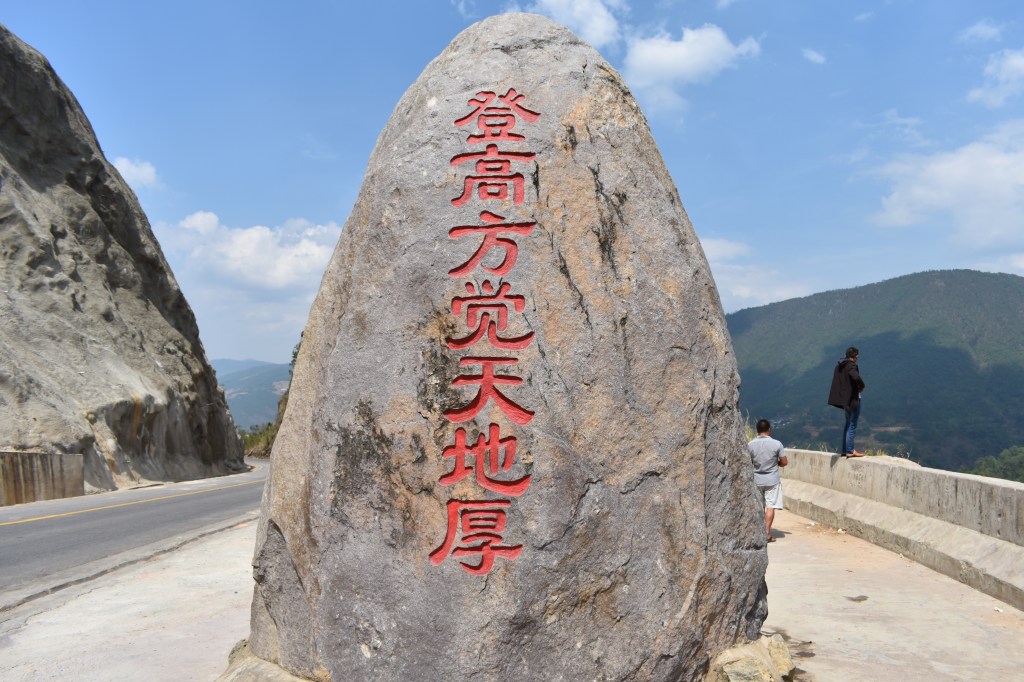
The following day feeling relieved that we can continue our quest we are up with the dawn and out of the hotel looking for breakfast. As we will learn, the Chinese eat a similar thing for breakfast each day and very rarely at home. I guess it’s cheap and easy to produce a large amount of food in a food stall or restaurant. More economical sense for the people to eat out. We actually knew this from when we were in Singapore. Todays drive will be quite a long one but at least the roads are good. They are over many stunning and beautiful hill passes. We are reminded as we pass countless road toll booths that ‘tolls equal good smooth roads’, as we found previously in Malaysia. As we made it to Pu’er yesterday, we have 180 kms head start on the itinerary. The engine is running well and it’s an amazing sunny day. We still have 450 kms to do so press on only stopping for a toilet break. And a break at the very top of a high mountain pass. The view is incredible. It’s high up looking down on to the river Lau Chu which heads down to the Mekong river.

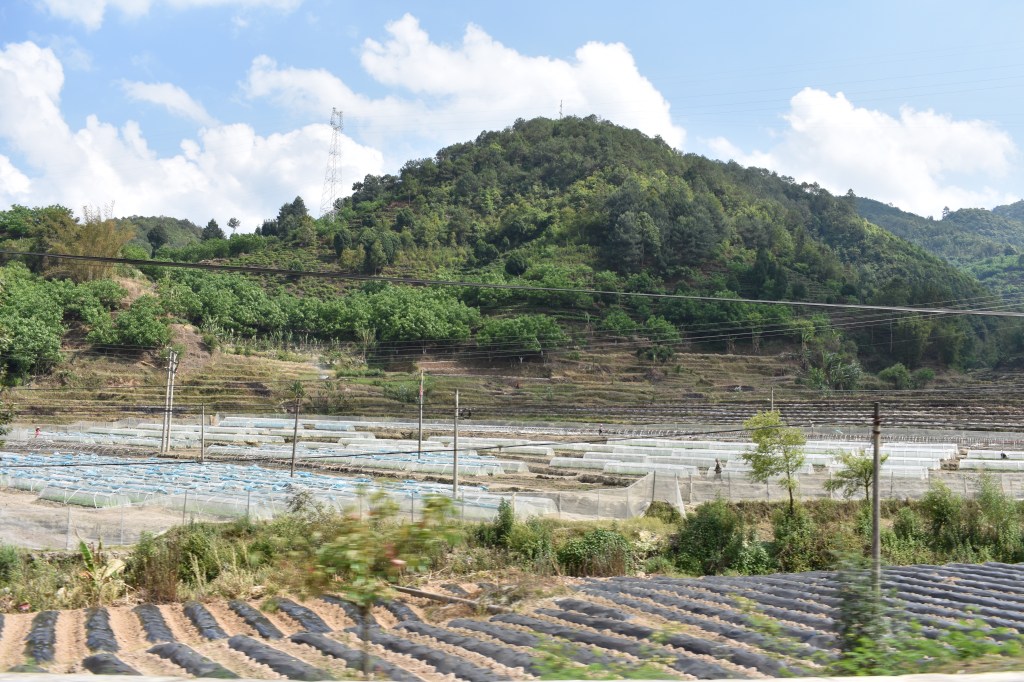
All the way we continue to see vast expanses of tobacco, rice, tea, and countless market garden all beautifully laid out producing vast quantities of fresh vegetables and fruit required to feed China’s huge population.

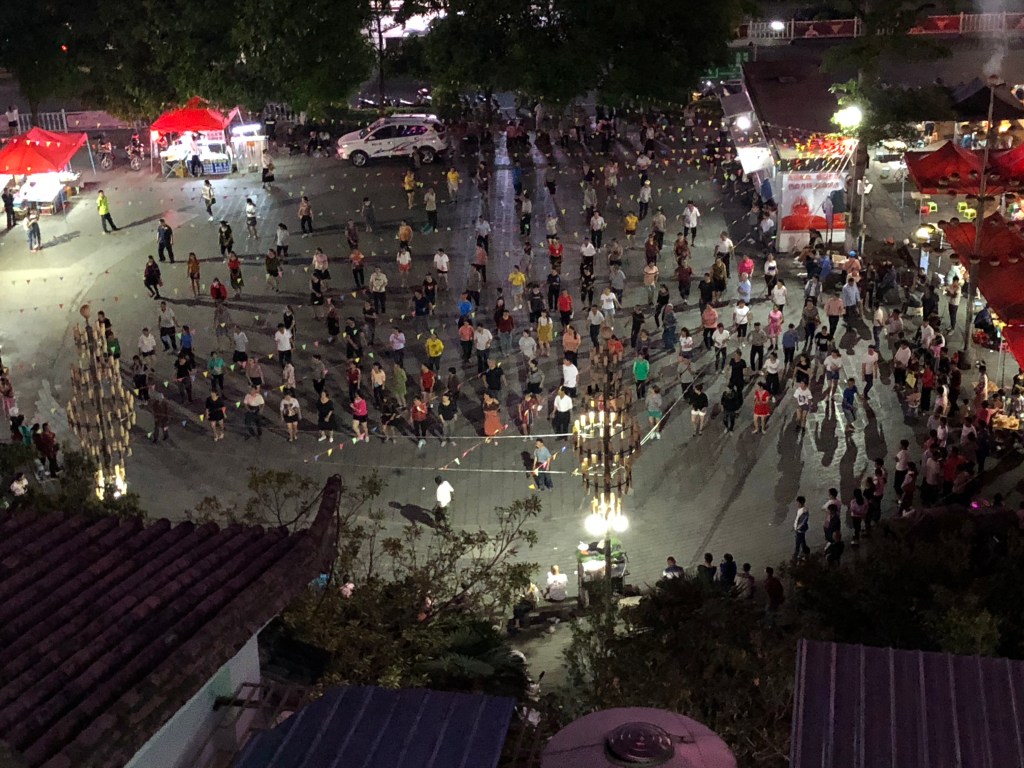
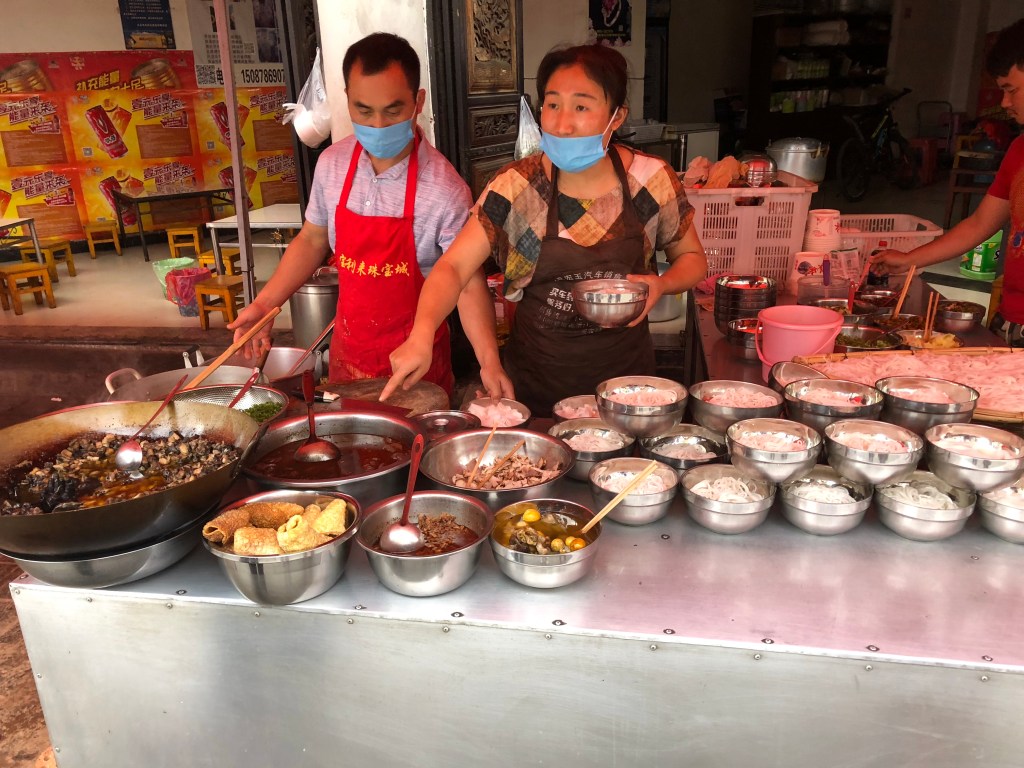
We have been too optimistic about going 450kms today so we stop for the day in Yunxian. A small provincial city of only one million people! Once again we have opted for the cheaper accommodation option, which so far has turned out to be more than good enough for us. It appears that most tourists that use the guides stay in high end hotels, making the guides stay in local hostels? Yunxian is a buzz with an almost carnival atmosphere. Mass dancing in ‘The People’s Square’. There are food stalls, shops, noises and smells.
Yunxian was famous in 1992, for the discovery of cranial remains of a species of ‘Homo Erectus’. Dating back 900,000 years ago, showing features of both ‘Homo Erectus, and Homo Sapiens’.
We have been pleasantly surprised so far by what we have seen in the two day of being in China. There is not the sense of oppression that we expected. The people are friendly and love Fred! They do however behave as if we are the first westerners they have ever seen. They stare and chat about us. At dinner a group of children appear and take photos of us!

Gone are the days of ‘ The little Red book carrying obedient Maoist, servants of the state’! Instead we get the genuine sense that the government, whilst still oppressive, and communist care about the people. We hear that they have banned litter, the removal of forests, and have legislated the construction of vast cities and infrastructure. And have encouraged the people to be self sufficient, by planting trees, and native bush, as well as the production of food on any and all available soil. The sides of the hills are terraced. In orderly and stunningly manicured areas of production.
5th May – Dali
We have had an itinerary supplied by the authorities prior to our entry to China, which I am guessing is to keep an eye on us and ensure they know where we are at any one time? This is somehow available to all the local authorities as we travel. Therefore we must adhere to it to ensure compliance. However Yingchu has had a look at it, and decided that there is a better route, and more interesting things to see. I think that she has also gauged us and what we want, plus what Fred is capable of driving in a day. The route is almost the same, and the minor changes don’t contravene any of the rules…….we hope?
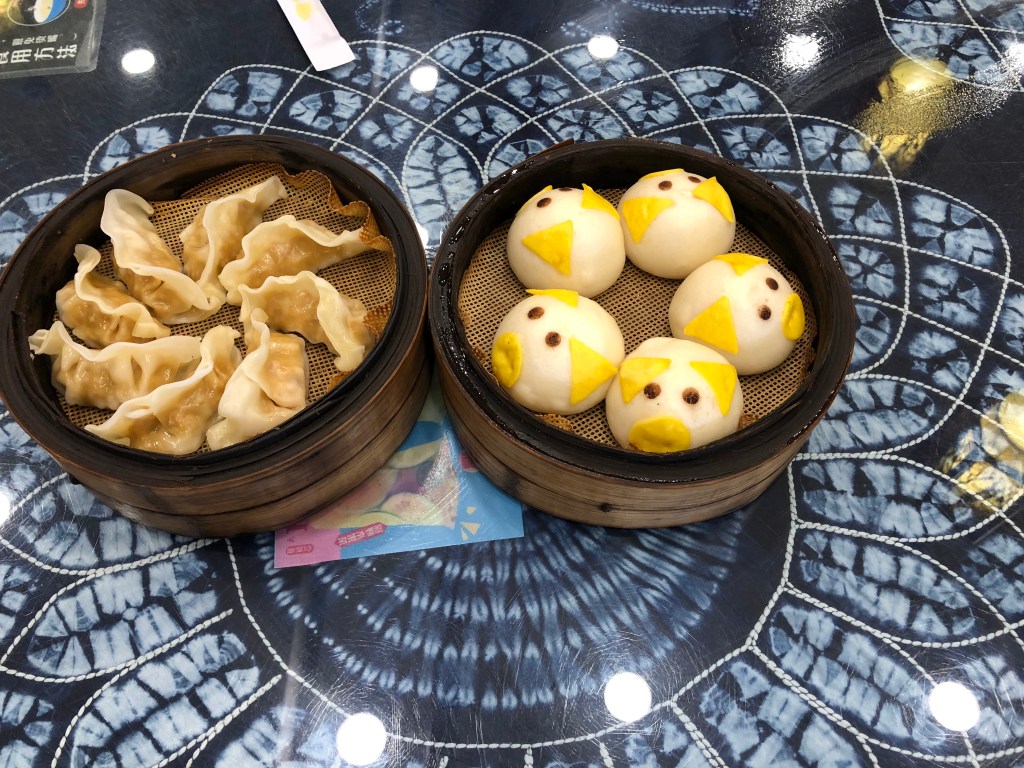
After a good breakfast of noodles and broth and tea, or if the little piggy dumplings take your fancy? I learnt later that they are cooked for the children to have on their way to school! and hope I didn’t deprive some poor child of their breakfast
Yingchu takes us further north. An easy day of only 190kms. The traffic is still appalling. Fred is behaving well, although at a toilet break for the girls, I check out a few rattles and squeaks. The first is a missing left hand bonnet hinge bush. And the second noise I find that the blokes who welded the gearstick back on have left off a couple of crucial struts and support bars underneath the centre console and drivers seat. Also the fuel tank filler seals that I made back in NZ have shrunk, meaning that when the tanks are full, there is a minor leak from the filler spouts. Tomorrow I will find a bike shop and get an old inner tube to fabricate new seals.
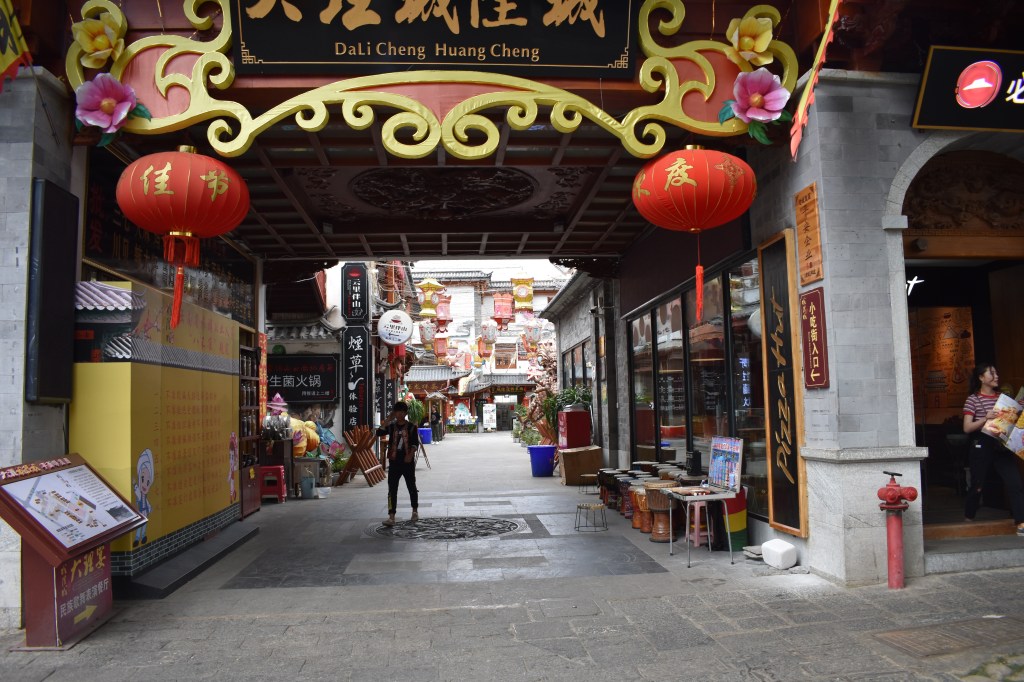
We arrive in Dali in good time, a tourist town that has strict codes of compliance for new buildings and developments, and any changes or renovations.
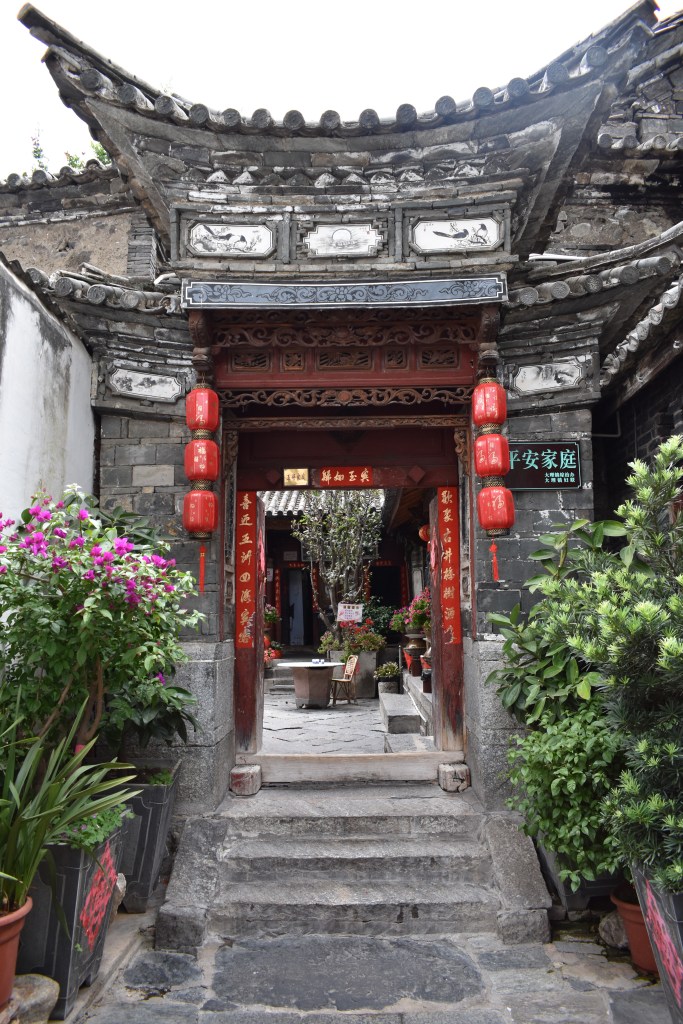
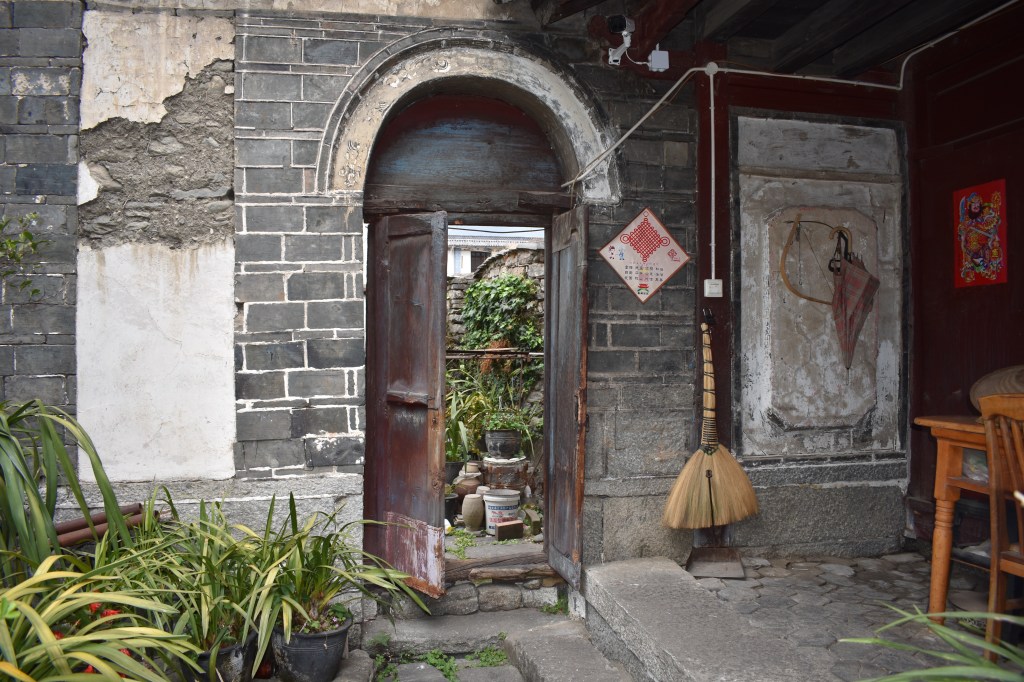
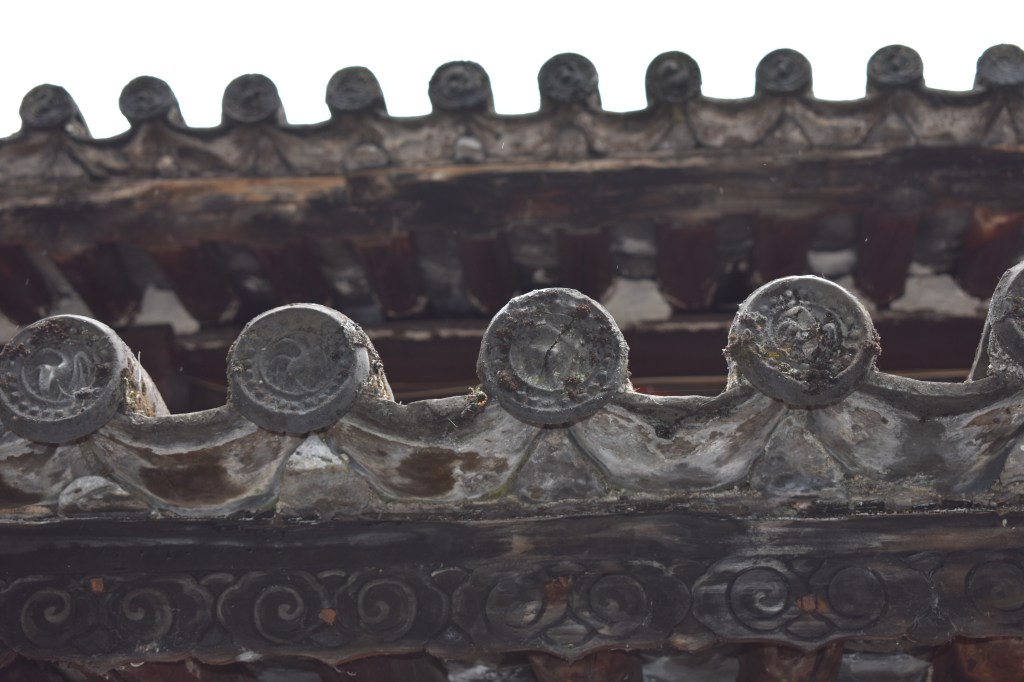
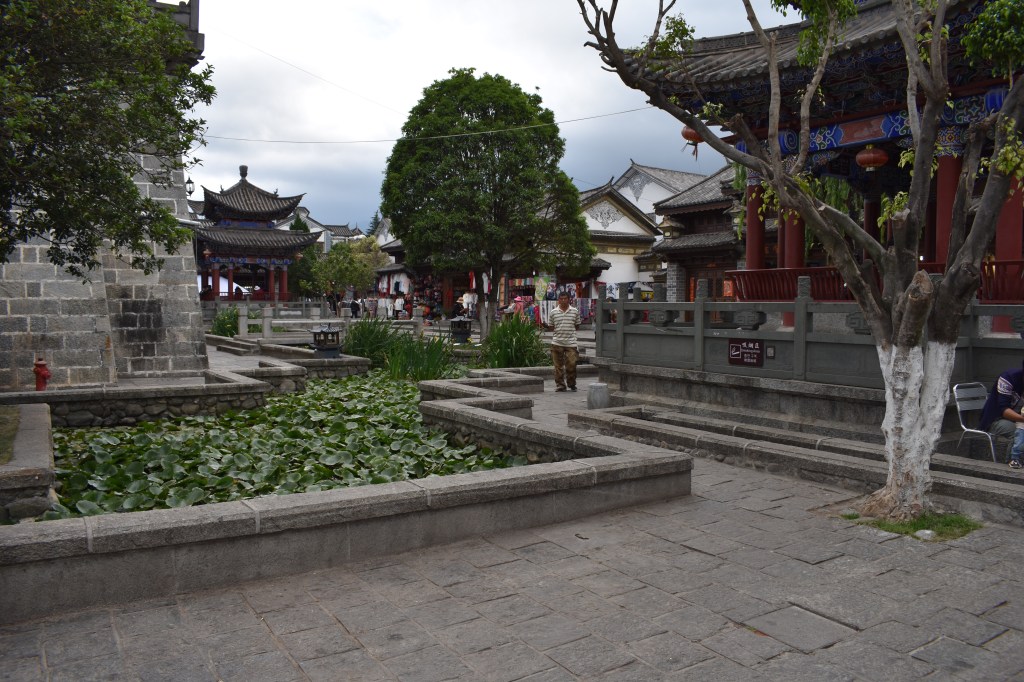
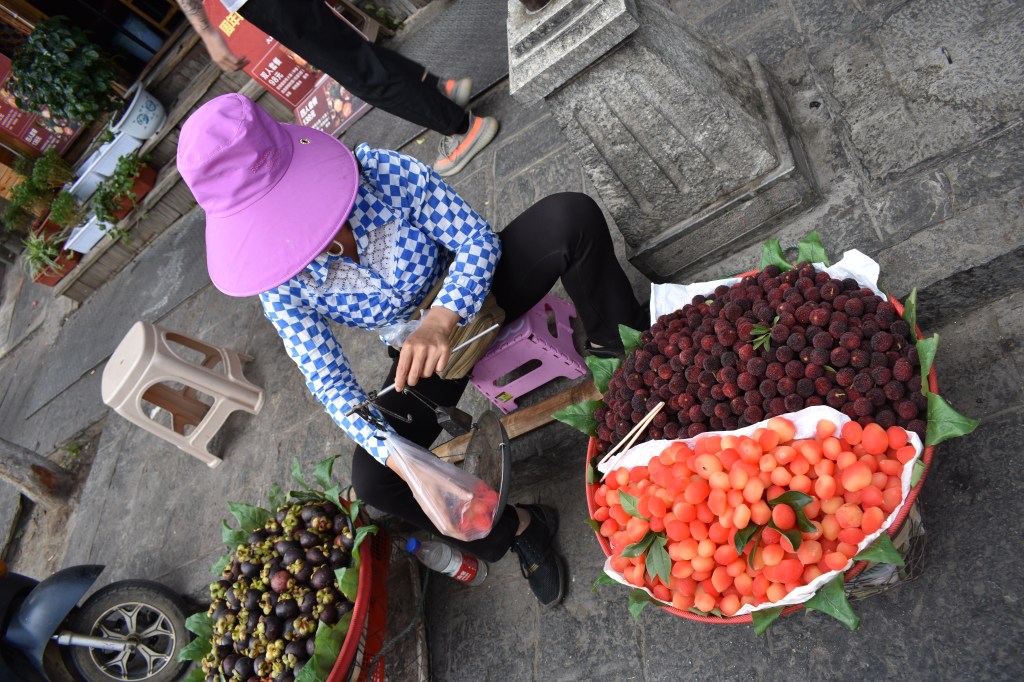
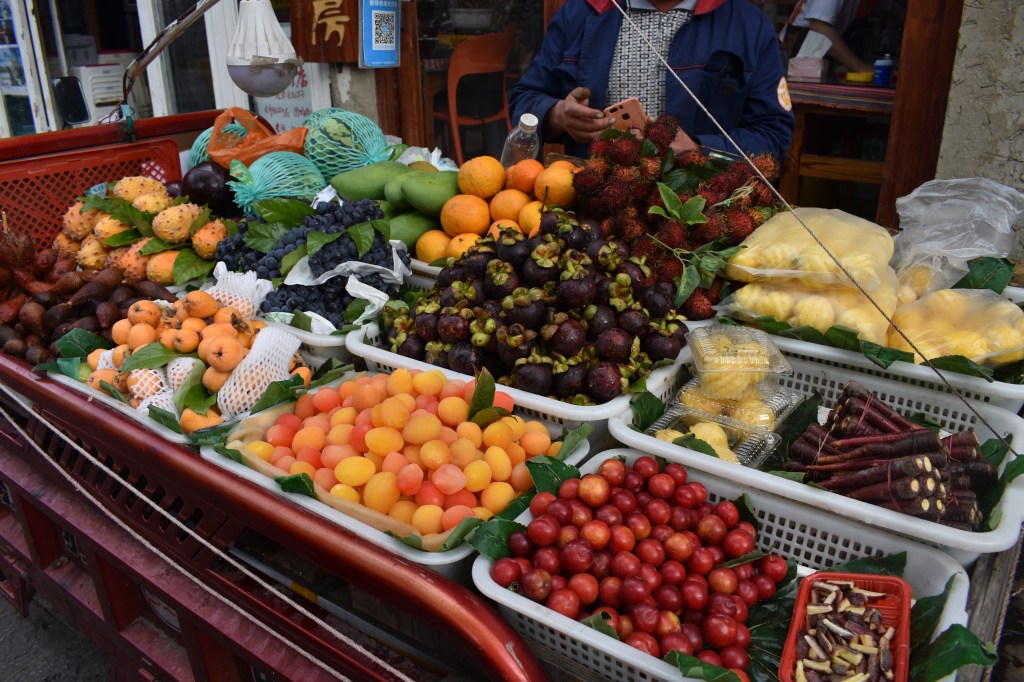
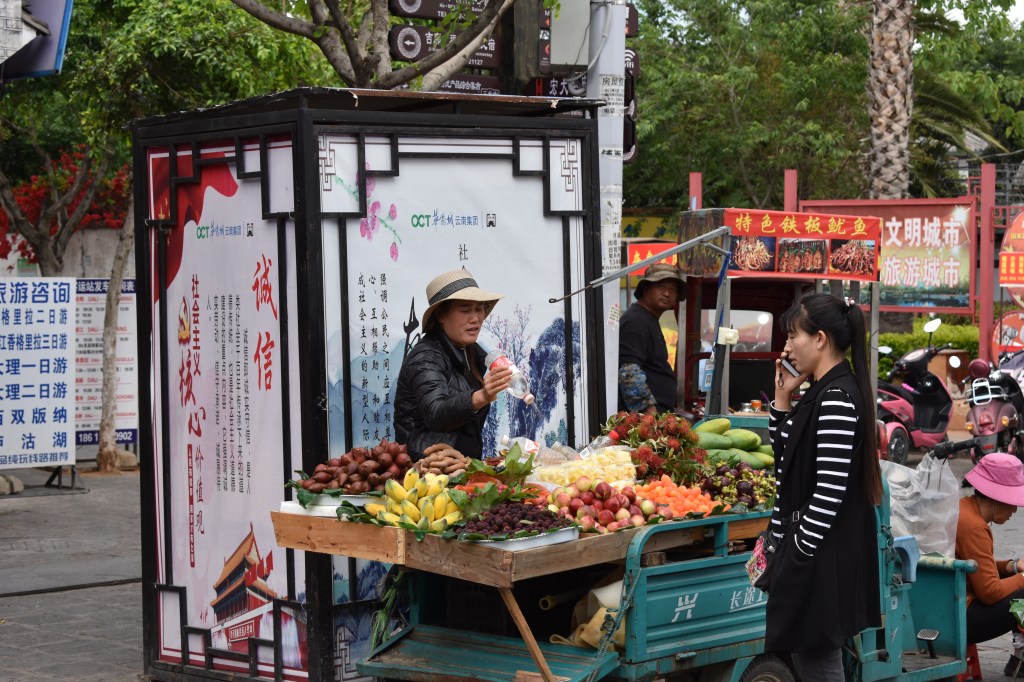
Our accommodation is a very nice old guesthouse. An old building in ‘old town Dali’. We find Dali to be very touristy! (lots of Chinese tourists. So NO westerners!) A place for trendy young people who dress well and appear affluent. The shops are in very old streets with shop fronts opening out on to cobbled walkways. No cars. Fashionable clothing shops. Shops selling tea, and food particularly fruit that is fresh and vibrant in colour.
The old castle has been rebuilt in traditional methods, and the cobbled streets are well kept and clean. It’s a much bigger place than I thought. So our walk/ stroll/wander takes a few hours.
When we get back to the hotel the girls rest while I head to Fred to fix a few things. Oil and coolant etc is checked. The points are checked. Then under the seats with a lamp (thanks Brendan Maguire for the work lamp that you gave Julia for her 50th birthday) to bolt back in place the struts and supports. I am reminded of what the time is by Julia and Yingchu who come and get me at 7pm! I’m covered in oil and dirt so have a quick wash then we head into the town to find dinner. A very relaxing and stress-free day. THANKS whoever you are looking out for us? (More about our luck later no doubt?) It might be coincidence, but it is also the anniversary of my father’s passing in 1985. I remember an awesome Brother, Uncle, Husband and Father, and toast his memory. 🥃 I am able to reflect on our adventure and how lucky we are to be able to undertake such a journey where the stakes are high and the dangers unknown. I have an over whelming sense of pride in the undertaking as well as my choice of travelling companion. I often wonder what he would say? and wish that he could have met Julia and our four children whom I am extremely proud of.
6th May – Lijiang
Today Yingchu takes us further north to Lijiang. Through stunning countryside with more of the amazing terraced and organised gardening we have seen along the way. Lijiang is another tourist town, and a UNESCO World_Heritage_Site. The streets are car free and very narrow. Beautiful old well preserved buildings.
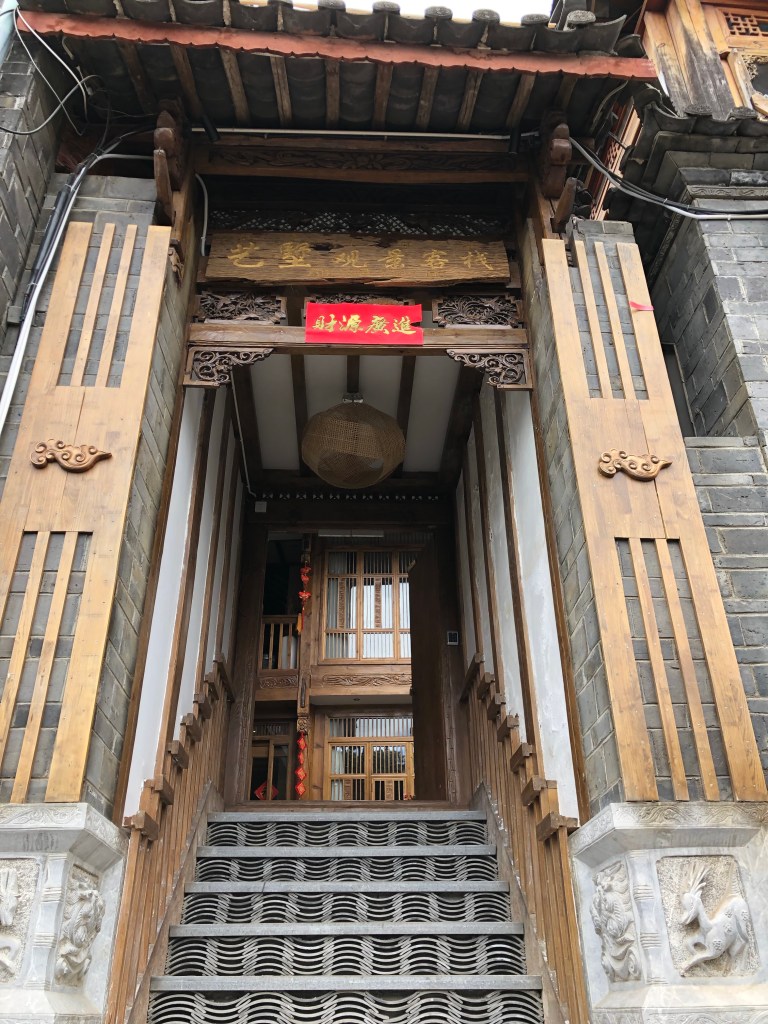
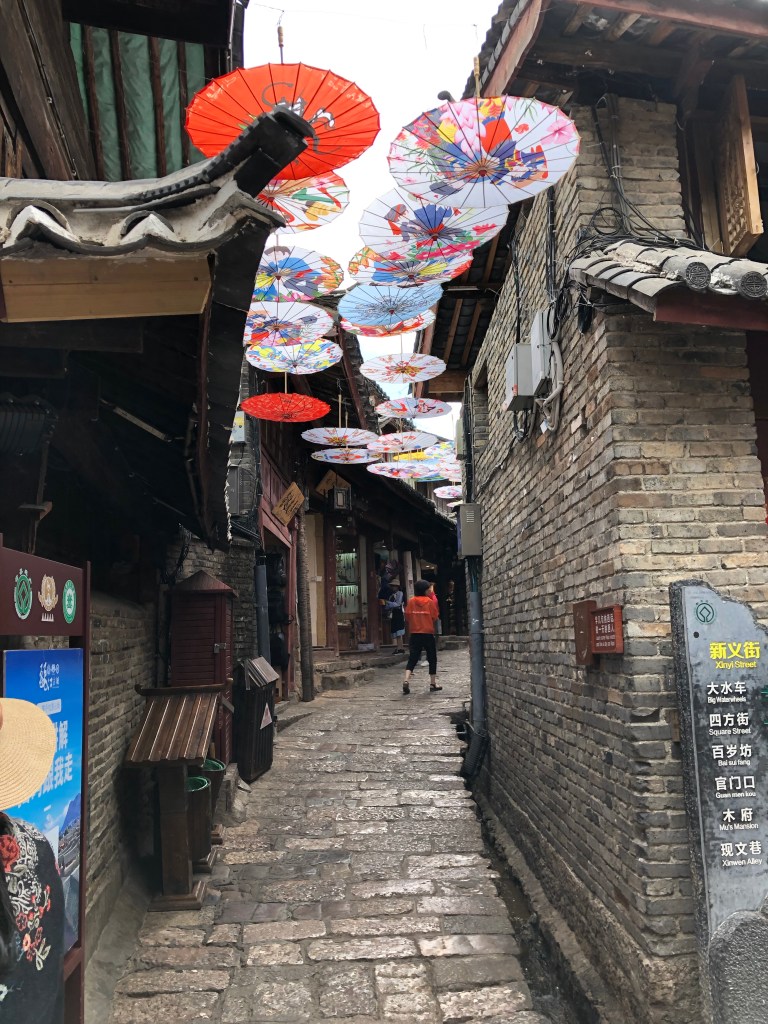
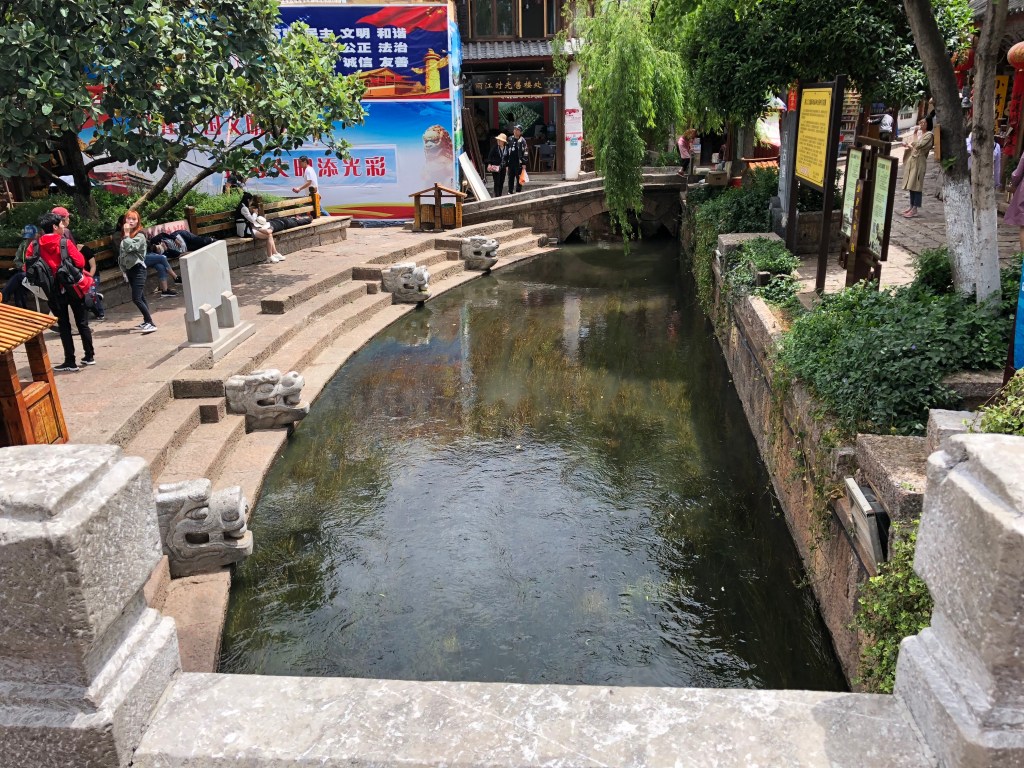
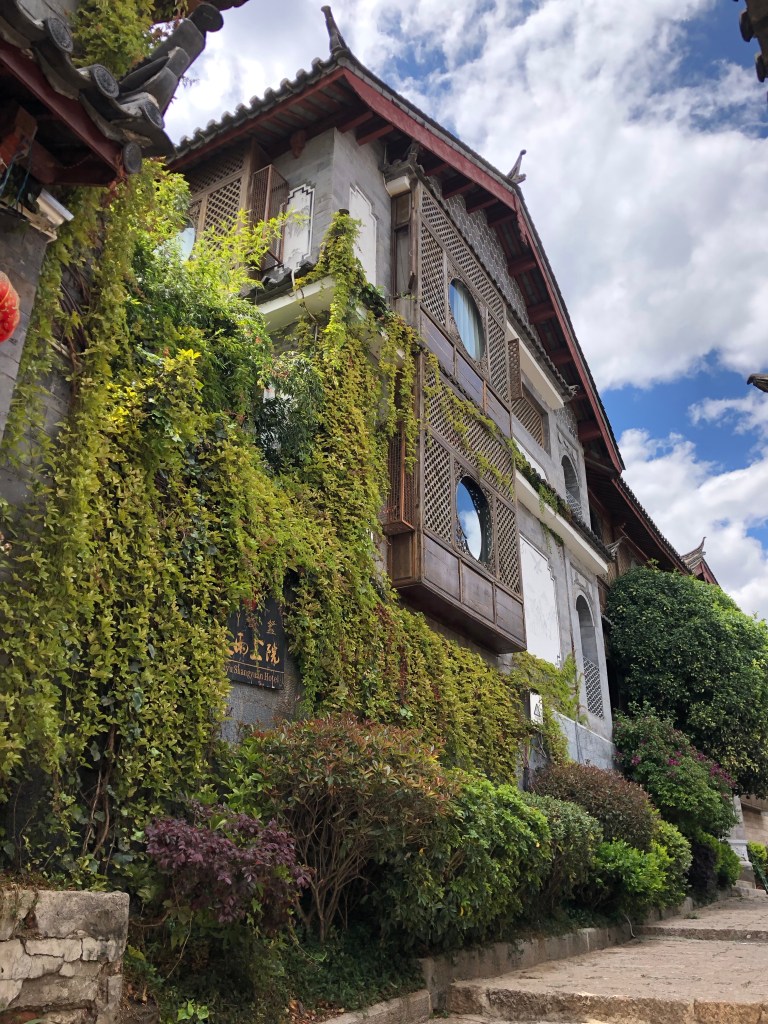
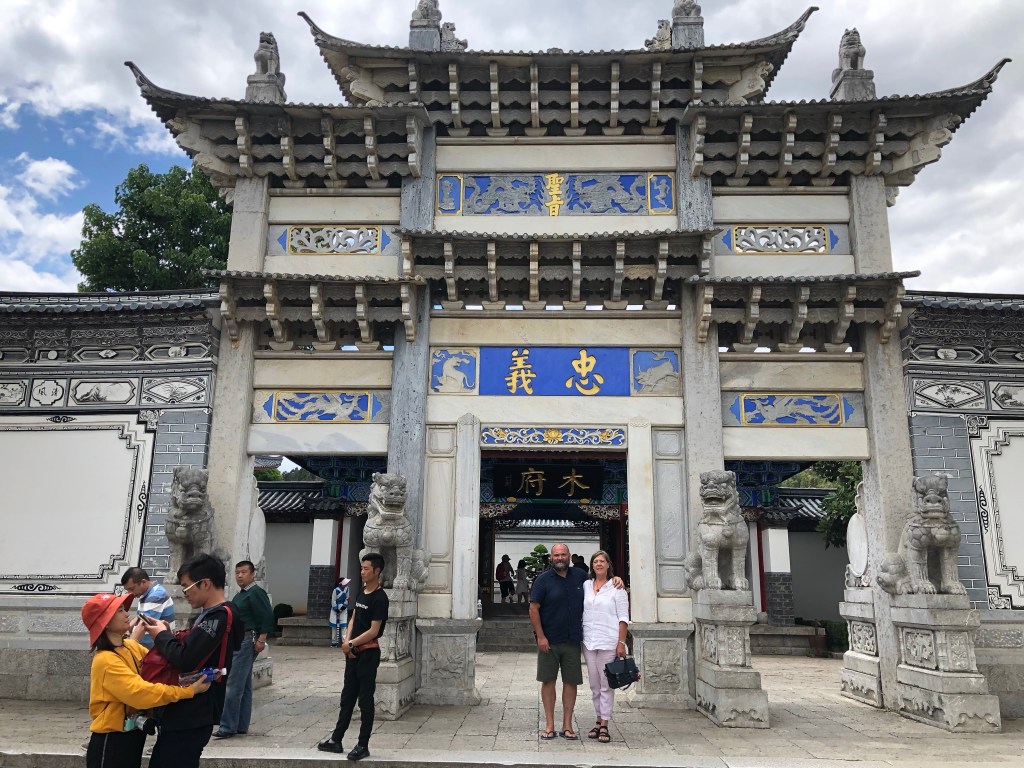
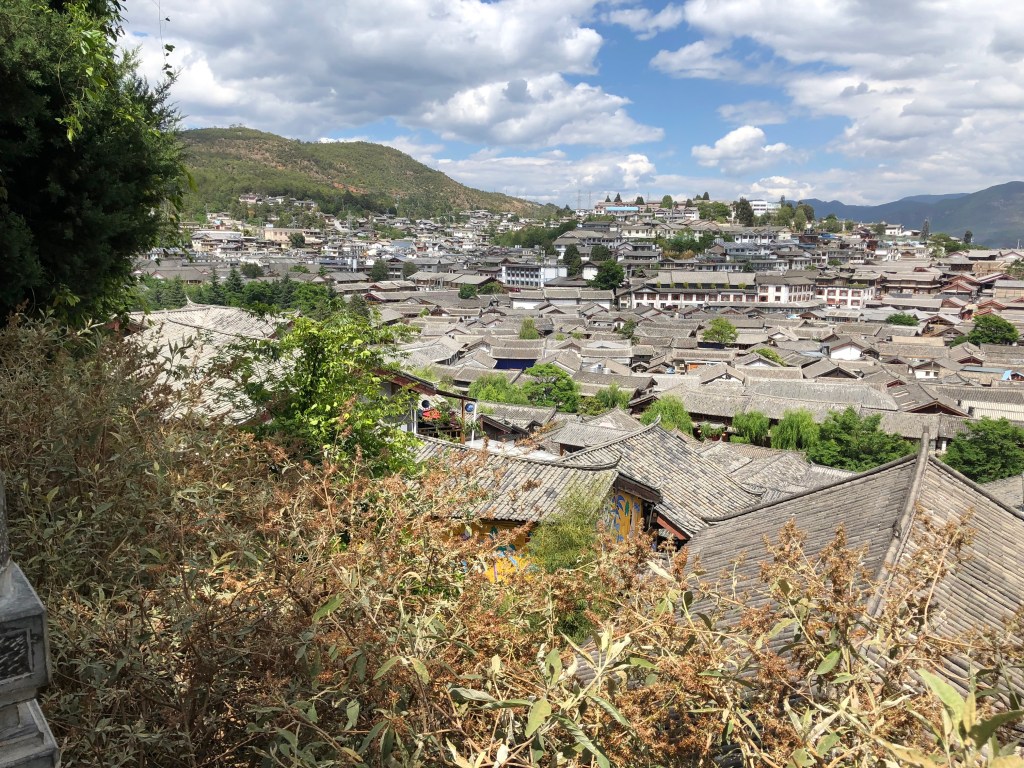
We wander again looking at the amazing shops selling tea in all shapes and forms, hawkers markets, and fresh fruit. The people are very trendy and appear to be on holiday. Some of the clothing is outrageous, but somehow suits them! We experience traditional “hotpot”, a copper chimney with a bowl attached around the outside. Broth and oil is heated and steadily bubbles away in the bowl heated by the coals within. Into the hot pot fresh meat and vegetables are placed utilising chopsticks, till cooked to your liking. This is a fun piece of kit. On our way home to our guest house that night we pass a stall selling the pots. They are hand made using only the simplest of tools. The craftsmanship and art of the pot doesn’t seem to be the main value as is the norm. The value of the copper appears to be the commodity, which the man weighs and prices on how heavy they are, and the current value of copper. The intricate patterns and workmanship are outstanding. We bargain him down a bit and carry our prize back to Fred to take home.


7th May – Miyi (Panzhihua)
Today we see the large variety of fruit that is grown and produced here on a large scale. Its a warm day perhaps explaining the presence of grapes, oranges, and mangoes. The mangoes hang on trees in vast plantations each fruit lovingly and carefully covered and protected by its own individual paper bag.
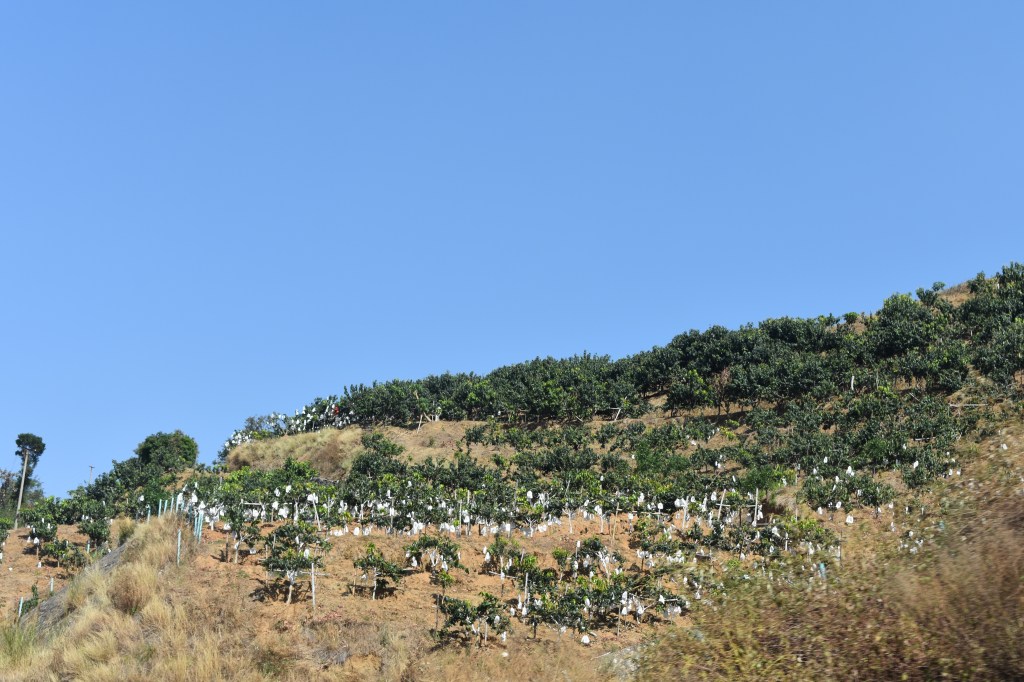
The hillsides are covered in small bushes and trees covered in white bags, quite a site. The roads prove to be long and windy. Five to six hours of raised stress levels due to the truck drivers who seem to own every inch of the road. we experience at least two to three near misses. Julia is good but still stressed about being on the left hand side nearest the traffic that is unpredictable. The heat is now high and the dust and tar which now has melted is proving uncomfortable. we push on a bit further to close the gap for tomorrow’s drive. 580kms to Chengdu.
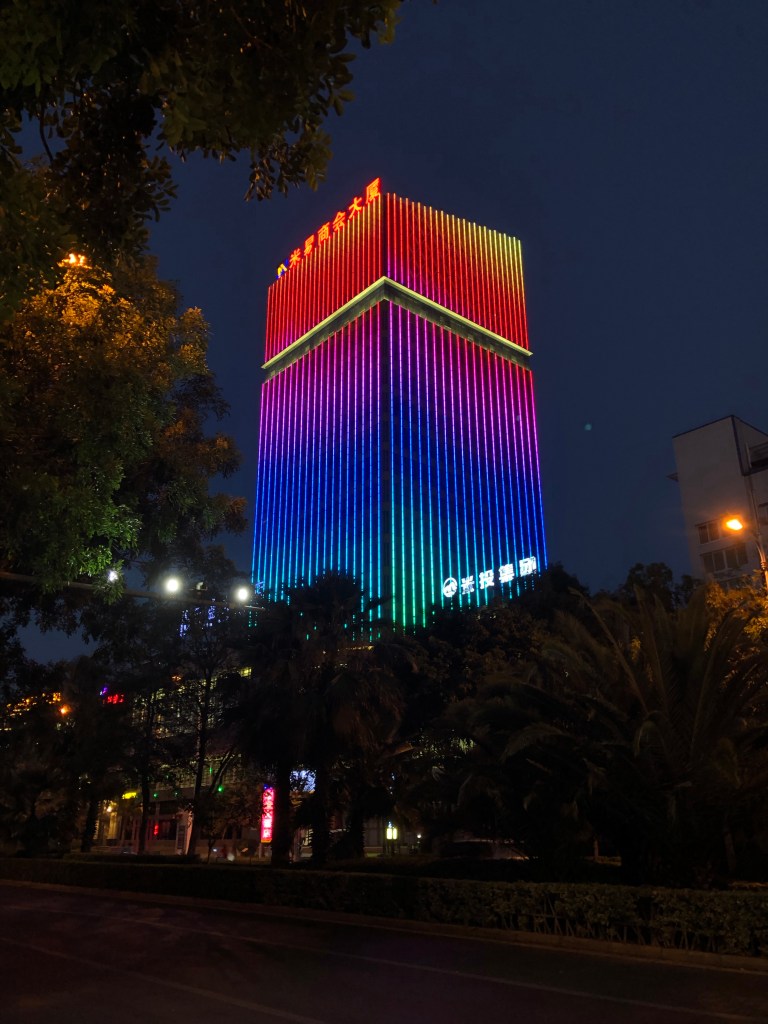
Miyi is a county town under Panzhihua City in Sichuan Province. The county is located along the southern edge of the Qinghai-Tibet Plateau. Our hotel is the Hon Sen Hotel which is brightly light up on the outside with dynamic electronic light displays.

Dinner that night is at a local restaurant where the menu is entirely in Chinese. Grateful for the presence of Yinchu who translates and chooses or food. We are the only customers, however there are three small children doing their homework at the back of the room. Its 8pm and they are being yelled at by the mother who runs the shop. Its an unusual situation. On the one hand awkward to be sitting in the same room that three children who possibly should be in bed being chastised for their academic struggles, and on the other feeling grateful that its not our children we are supervising. Back in the hotel which outwardly looks quite upmarket and flash we find that the room has an awful smell much like last night. the toilet is blocked and smells the whole room out. we call reception and ask for a maintenance person the come and fix the issue. shortly after the call a knock at the door reveals a smiling woman wielding a dish mop!! she promptly plunges what appears to be a useless devise into the toilet until it clears. As soon as its done, she leaves as she arrives waving a wet hand mop in the air. Its clear but the smell remains is “gagworthy”. The plumbing and drainage we will find will become quite a feature of the trip at both ends of the technological spectrum. Ancient and dilapidated, as well as very ancient and technologically advanced and fascinating (for its time).
8th May and 9th May – Chengdu.
Having had two nights at guesthouses where the plumbing has been decidedly average to poor. Where the smell has been pretty appalling, Yingchu books our hotel knowing that its is well maintained and has self-flushing toilets with heated seats of all things. She will be staying with her brother. She tells us that the two children were both born during the time of the ‘single child’ policy. The parents were so happy to have them that they gladly paid the fine that was imposed upon them.
Chengdu is a modern city Chengdu is now one of the most important economic, financial, commercial, cultural, transportation, and communication centers in Western China. Chengdu is located in central Sichuan. The surrounding Chengdu Plain is known as the “Country of Heaven” (Chinese: 天府之国; pinyin: Tiānfǔ zhi Guó) and the “Land of Abundance”. Its prehistoric settlers included the Sanxingdui culture. It is also the site of Dujiangyan ancient irrigation system, and is designated as a World Heritage Site. The Jin River flows through the city.
https://www.travelchinaguide.com/attraction/sichuan/chengdu/panda-breeding-and-research-center.htm
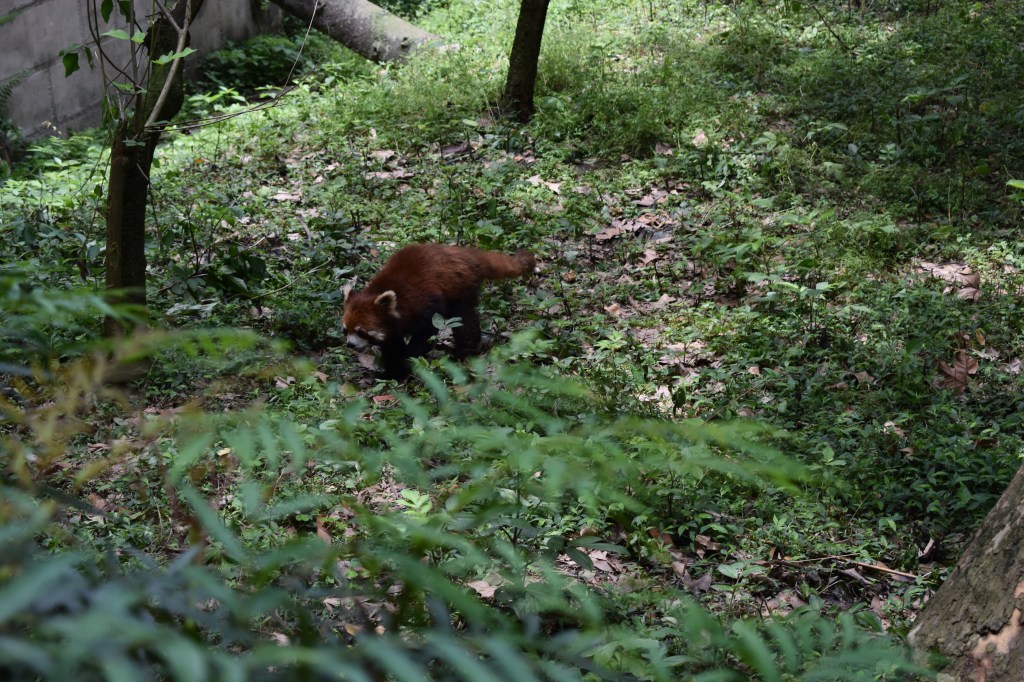
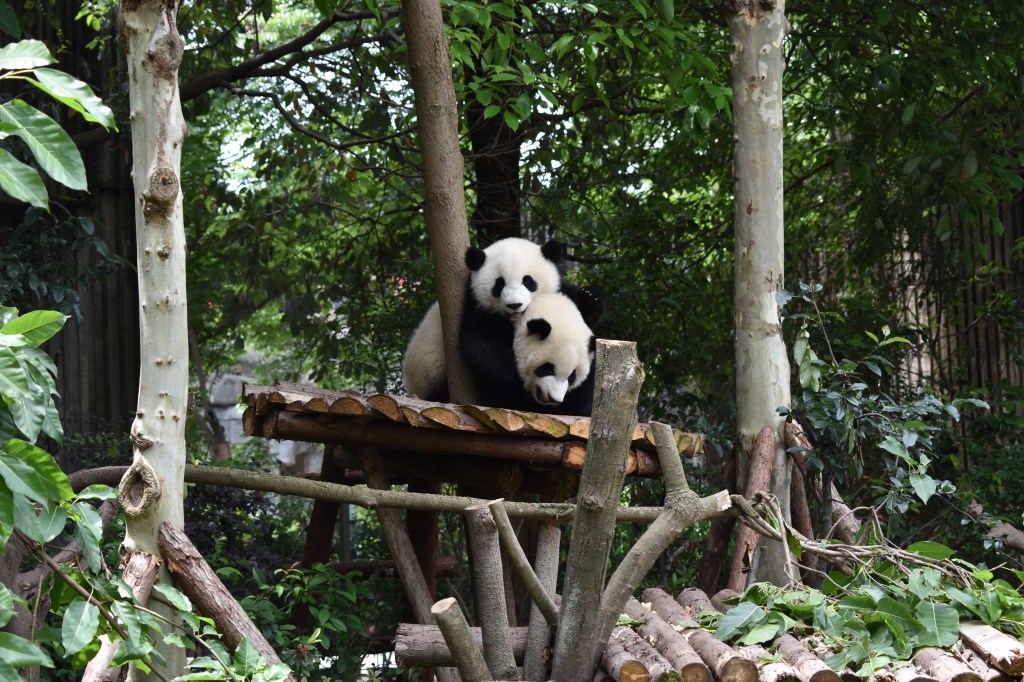
The Chengdu research Base of Giant panda breeding project is very interesting and extremely impressive. They are the symbol of The World Wildlife Fund (WWF).There are 144 Pandas in residence. The centre was designed to counter the trade and export of pandas that almost decimated them at the start to the last century when pandas were taken from the wild and sent over seas as gifts or “souvenirs for the rich and wealthy Americans, who exhibited them overseas. Many were given as gifts by the Chinese government to foreign dignitaries. The Centre has selected the healthy gene pool for their survival. The population is once again growing. they are a high mountain animal that eats low calorific food such as bamboo and vegetation. They come across as being slow and lazy animals but this behaviour is self preservation they are conserving energy. The Panda has one to two babies each year, of which only one generally survives due to the instinct to feed only one to ensure survival. At the centre they take one away and alternately switch the babies around placing them with the mother who is none the wiser of the “old switcheroo”! This ensures that both are given food and sustenance equally. This program is world wide and hugely successful. I can see why our Prime Minister of the time bought into the program. A wonderful thing to do not only for the planet, but for New Zealand to be able to take part in helping to conserve and prevent the extinction of the species.

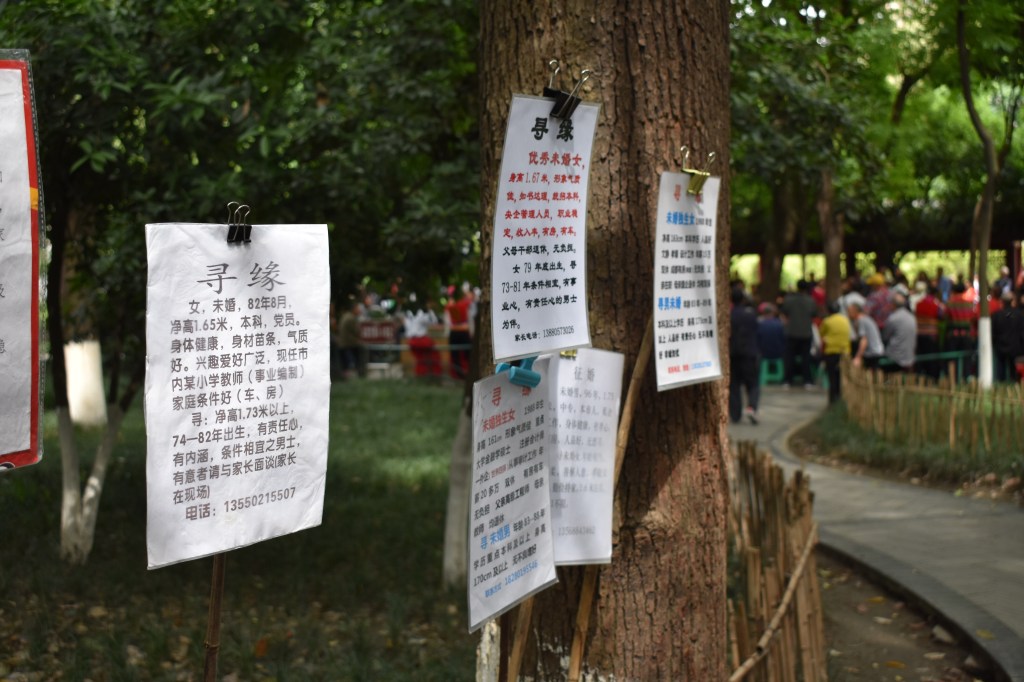
Many of the big cities have what is known as ‘The People Parks’. A central area that each day the people gather and perform drama and opera, music using ancient instruments, or as in one area, parents gather and ‘advertise’ their children for marriage or partners. The ‘children are mostly of the age where they nee to leave home!! Parents leave details on a poster that is placed on a fence for all to read and see. the details are like a CV or resume many are successful business men and women quite a show.

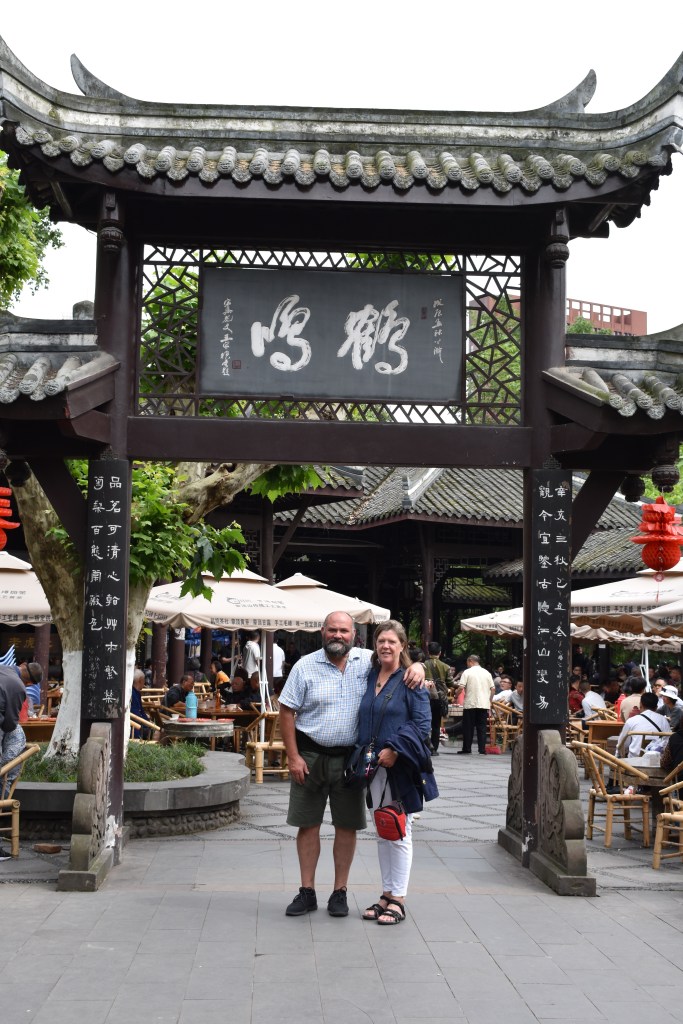
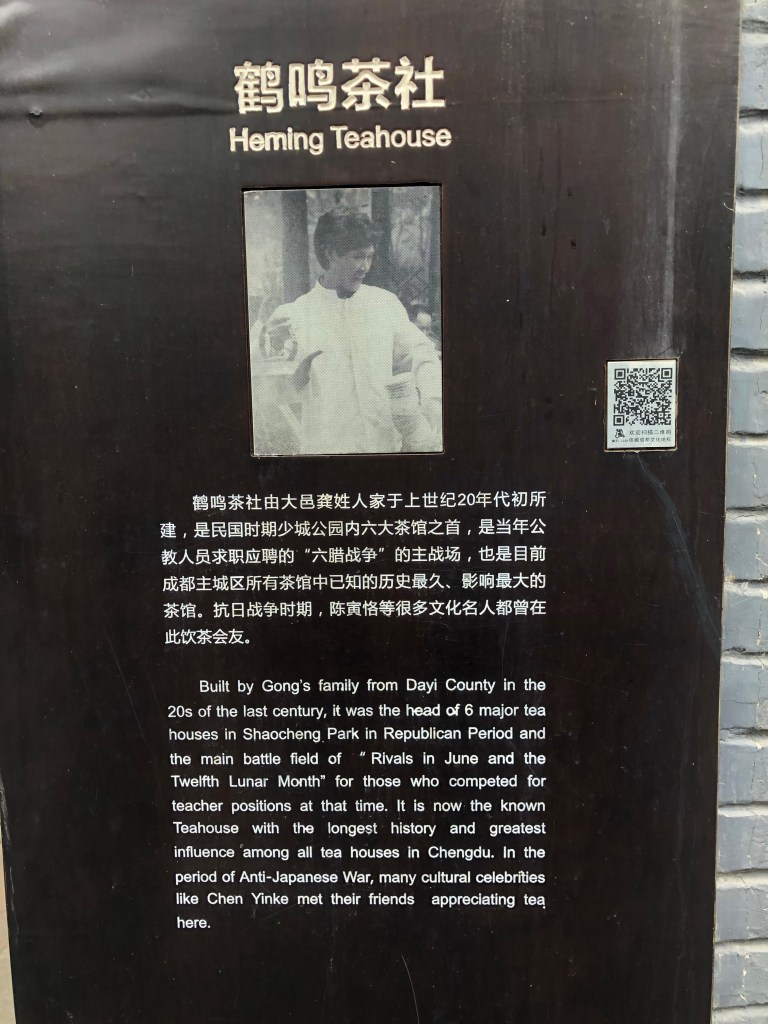
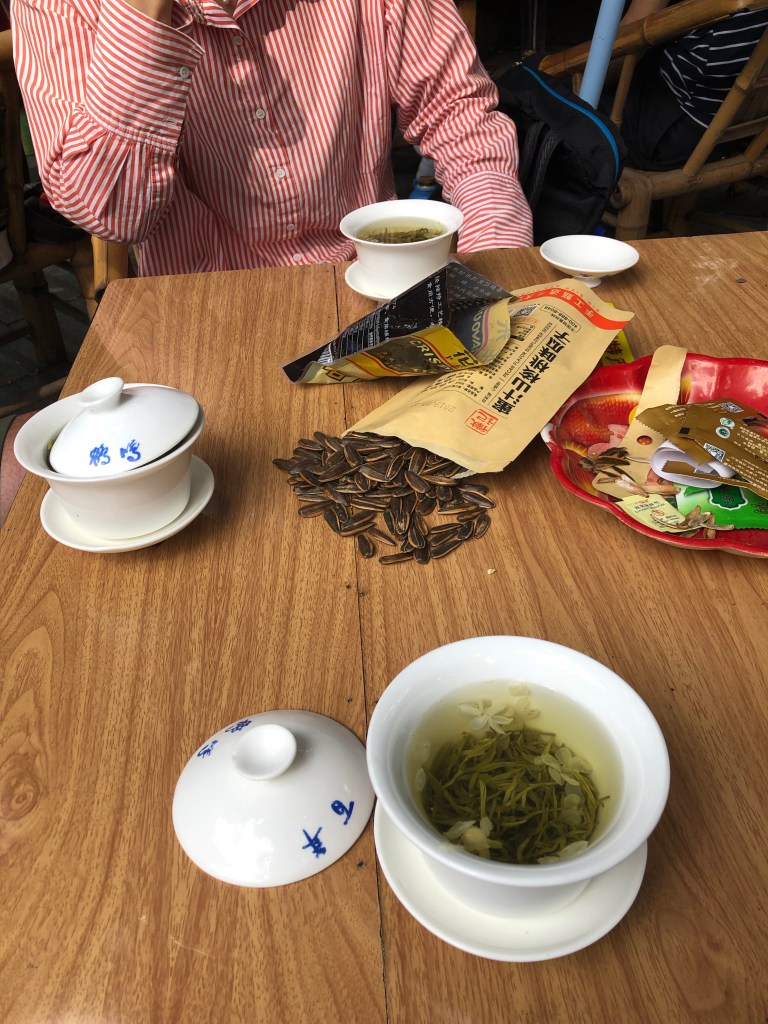
the park also has a lake where they row boats etc. nearly all parks have a ‘tea house’ where they choose tea from a menu and sit and chat or play Mahjong or cards. The tea arrives at your table in a small bowl that has a lid. The loose leaf tea is then steeped in hot water (no milk) served from a large thermos jug. The leaves taste better after a couple of top ups. Also available are packets of sunflower seeds that are hulled and thrown on the floor. It is a very civilised, relaxing and sociable place, enjoyed by the masses of people of all ages who can easily while away a couple of hours. You can even enjoy a massage of the neck, head, or hands administered by hawkers who appear to be quite rough but obviously effective.

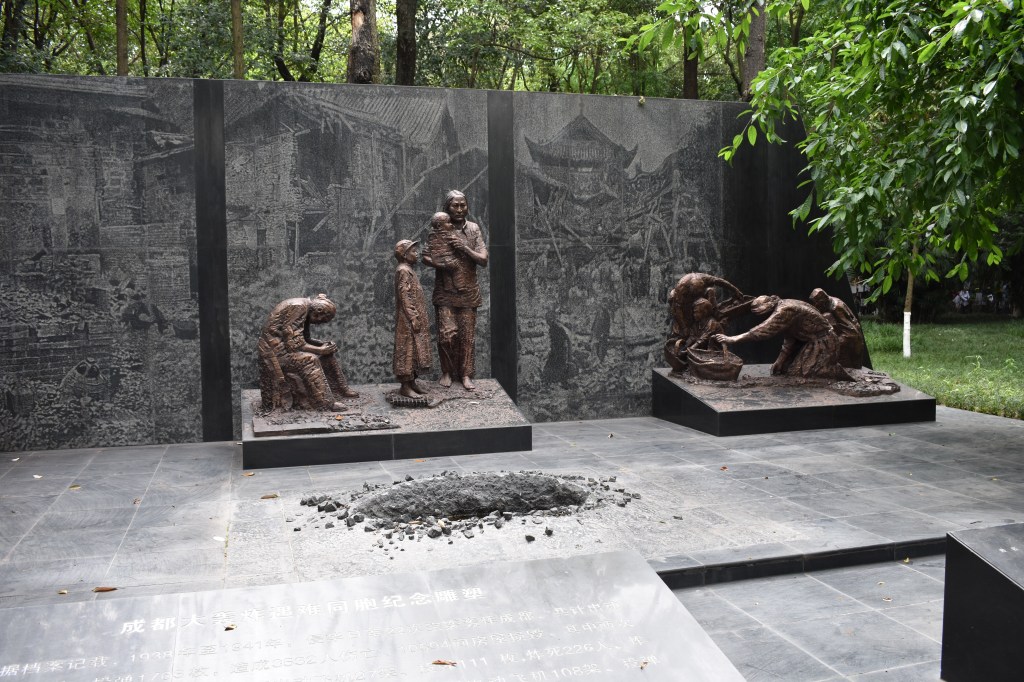
Between 1938 and 1941 the Japanese bombed Chengdu. the relationship between China and Japan was not a pleasant one. This is remembered with many statues and carved walls depicting the appalling treatment they endured.
That evening Yingchu once again stayed with her brother leaving us to fend for ourselves.
10th May Songpan.
https://en.wikipedia.org/wiki/Songpan_County
The roads are once again awful and very hilly. The last hour of the day is driven in torrential rain and and fading lightand at an altitude of 2,900 Meters. Poor Julia’s nerves were stretched!
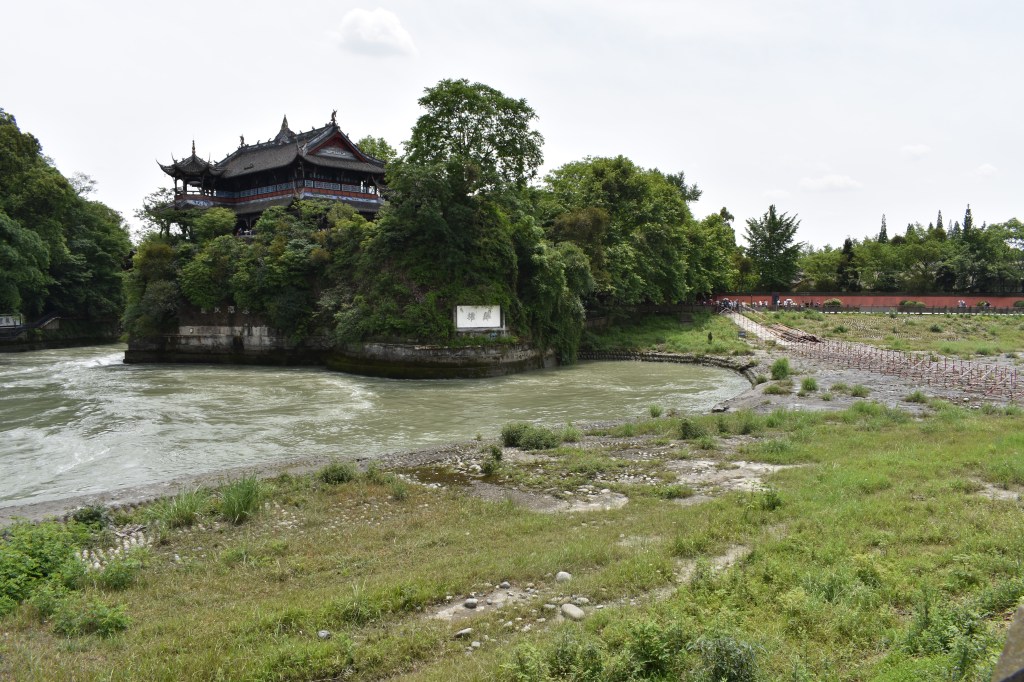
On our way to Songpan, just out of Chengdu we stop at the site of the Dujiangyan irrigation system, that is designated a World Heritage Site. The Jin River that flows through the city is cleverly manipulated by way of an amazing 2000 year old engineering marvel. The engineers utilise the water course to redirect the flow to the city for drinking water and waste management, as well as irrigation to the neighbouring agricultural fields. The use of elaborate statues of horses and bronze bars laid in the river bed indicate when the riverbed requires dredging to maintain the efficiency of the system. Its magnificently grand yet so simple.
Songpan is an ancient walled town. The ancient city of Songpan was built during the Tang dynasty and later rebuilt during Ming dynasty. Songpan was an important military post. It was also an important economic and trading center for horse and tea exchange between Sichuan, Gansu, Qinghai and Tibet
11th May Langmusi.
https://en.wikipedia.org/wiki/Langmusi
A much nicer day today, as we climb to 3800 meters. The snow covered hills are something else. All along the roads and expressways there is a huge amount of effort being made to keep them clean and attractive, by mass planting of trees (pine and willow etc) and plants on the verges and hillsides. May of them are so new that they look like rows of stakes not trees. The ‘stakes’ are willow saplings stuck in the ground, that grow rapidly into lush green trees. Many of the towns that we travel through have entrances that have tree lined avenues. Many of these towns and cities are still in the throws of construction.
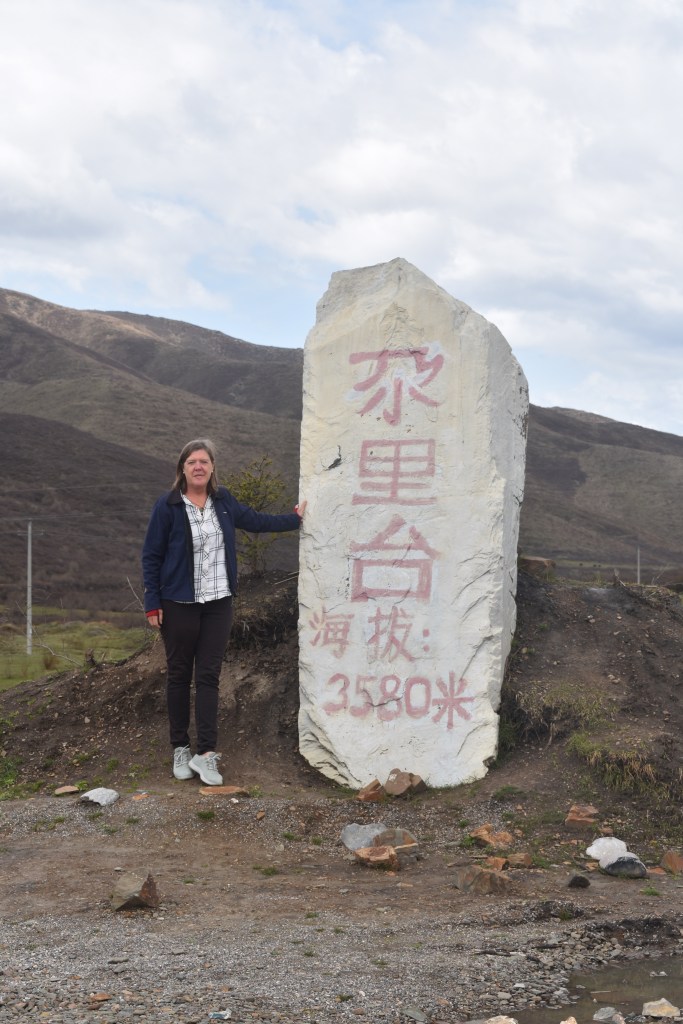
After a long haul to the top, we reach the plateau and the wide open plains where the Tibetans have made their camps. Here vast herds of yak and long horned sheep graze, tended by nomadic horsemen who’s ger/yurt camps are now permanent or semi permanent. At each camp we pass stalls selling dog hides and fur as well as yak ‘balls’ (cheese). Being horsemen there are of course hundreds of horses wandering freely. The expansive plains are absolutely spectacular.
As we approach Langmusi, we see locals busy rebuilding and working on their homes. It is a ski resort in the winter months, so I suspect and sense optimism in the people readying themselves for an influx of tourists. Tourists in this case are all domestic Chinese visitors. As with other places we’ve been the people are very friendly. Every where we go we hear, an accented and happy “Hello”called out from them.
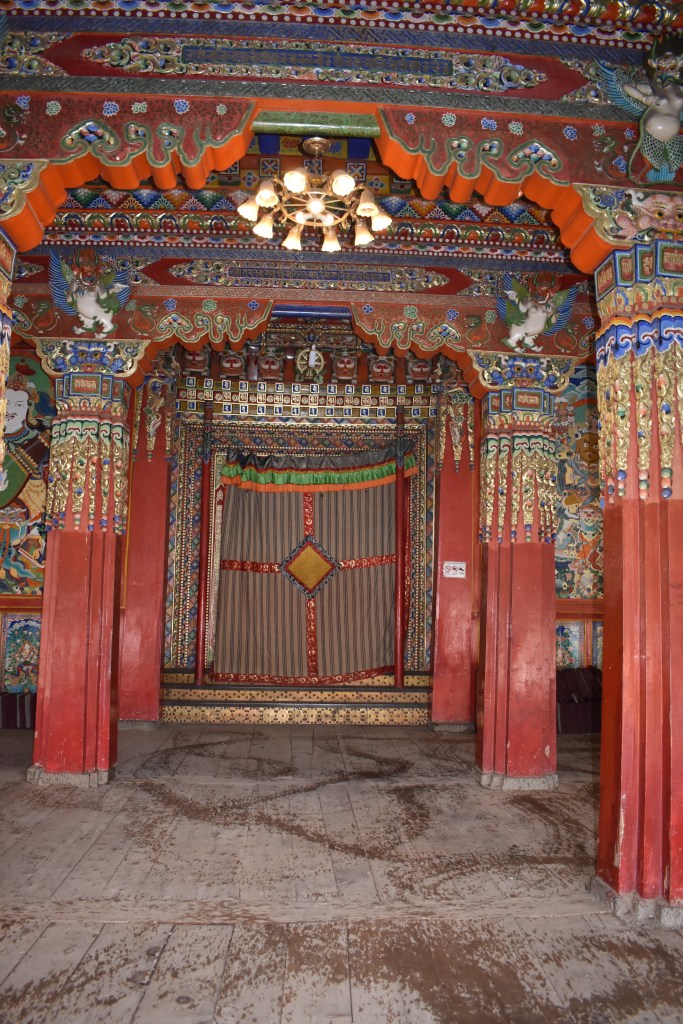
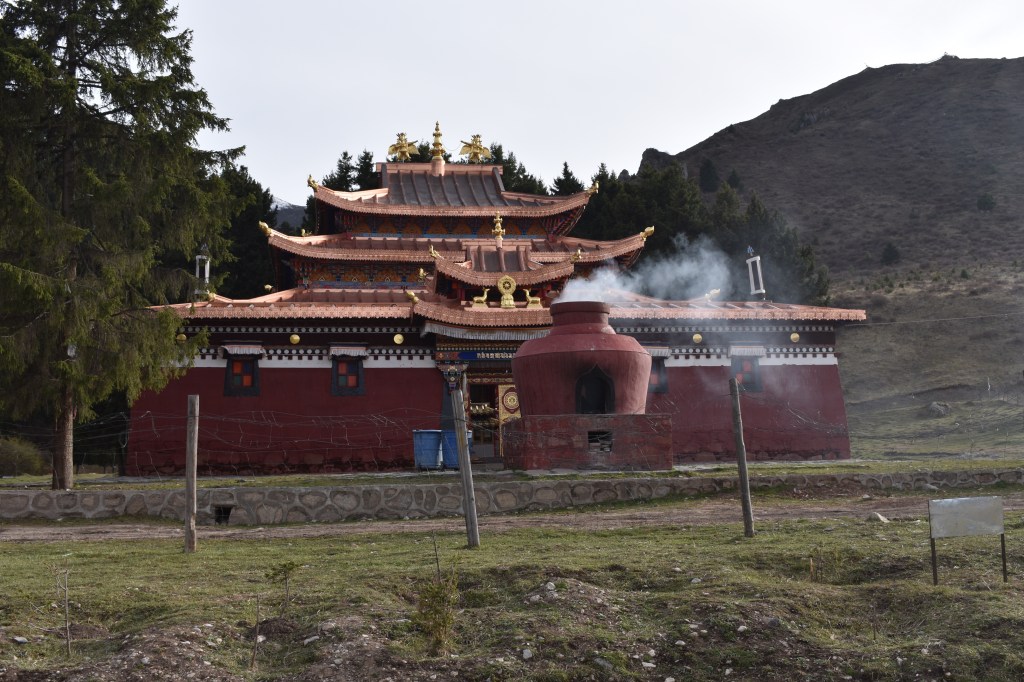
Langmusi is the site of one of the many important monasteries that are throughout China. This one is a sect of the “Yellow Hat” monks. The Gelugpa (Yellow Hat) order is the youngest school of Tibetan Buddhism (founded by Tsongkhapa (1357-1419). It is the largest and most important of the Buddhist orders, and is lead by the Dalai Lama. The huge monastery is set in the hills with a vast collection of buildings in various states of repair.
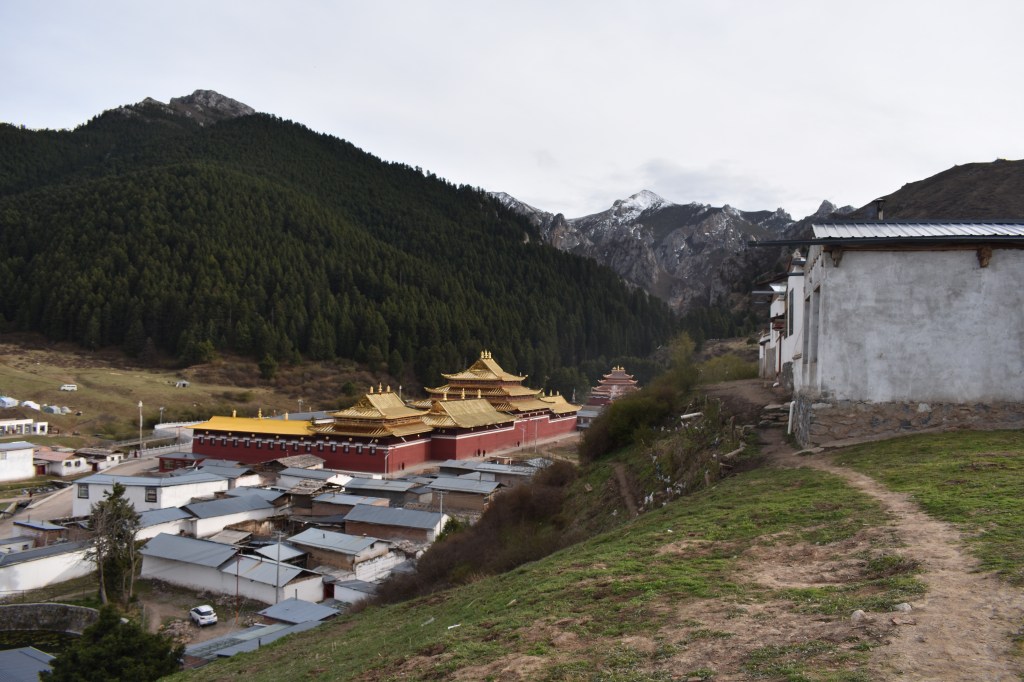
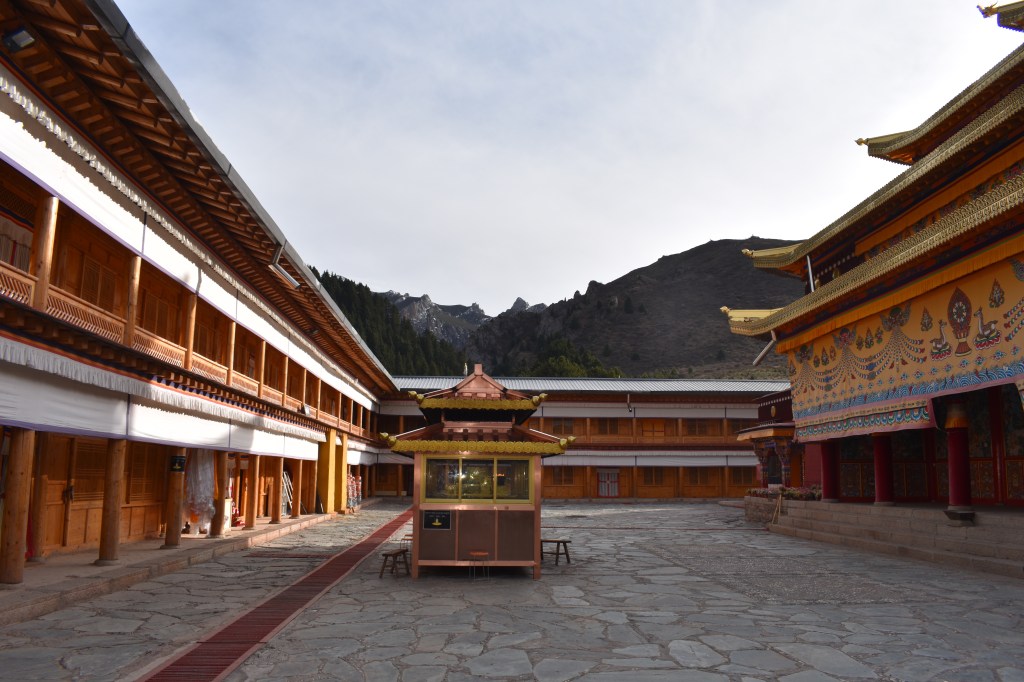
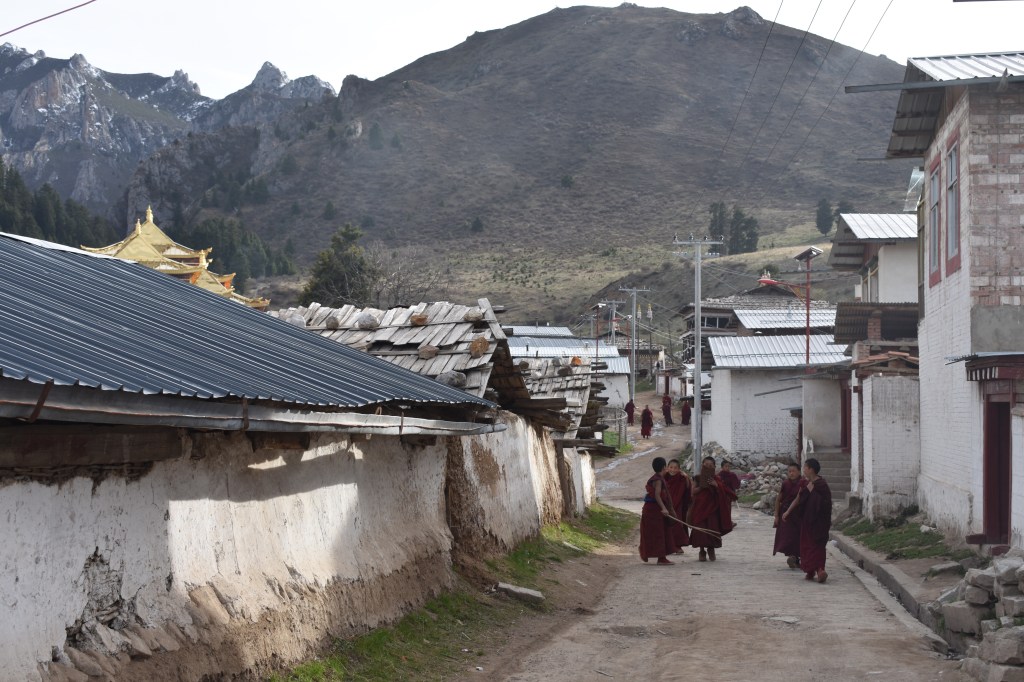
As we wander through the grounds, the small boys and men (all monks) with warm skin boots and robes smile and greet us with the usual cheery “hello”. They all appear to be a lot older than they are. This might be because of the relative basic conditions in which they live or the general cold weather? I’m not sure. The personal accommodation is sparse, very sparse. There are four people to a small stone walled unit. The units have a thick ornately carved wooden door and cells inside. I can only imagine what it must be like in the winter.
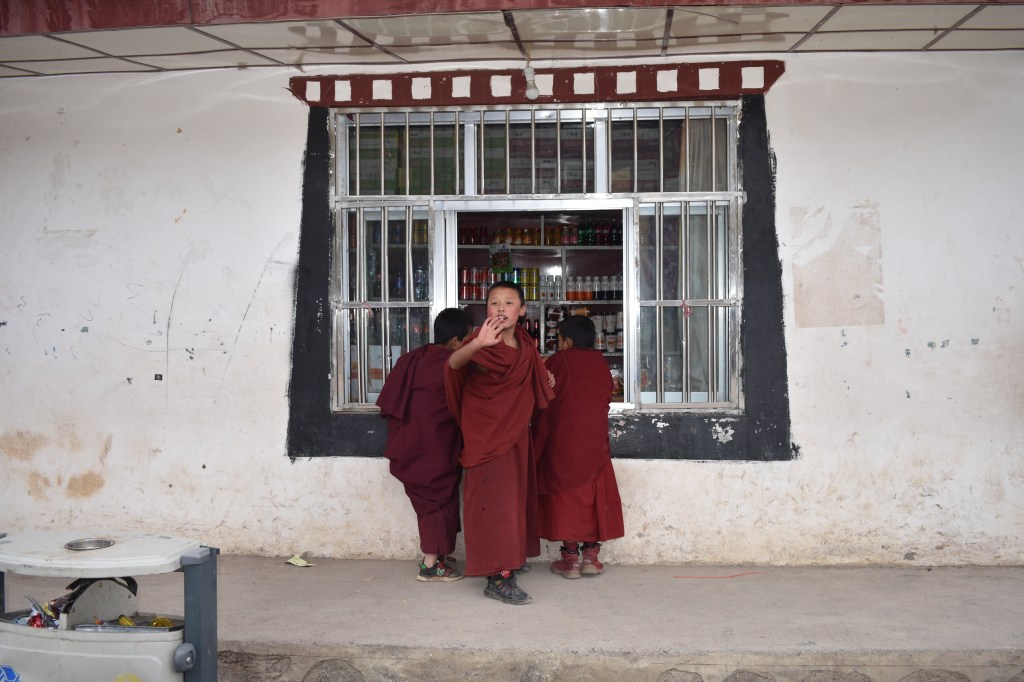
The youngest of the monks start at six years of age. They seem happy enough. Often in groups with their arms around each other’s shoulders. It reminded me of my own boarding school actually in that we had the same strong bonds, friendships and company in a semi isolated setting (except that Stonyhurst was infinitely more luxurious). As you go further into the site, we pass groups at a ‘tuckshop’ window or at the small shop, where they can buy socks, shoes or soap etc. and then hear the sounds of chanting at the main temple.
We do not have permission to enter but see them gather with their heavy robes on, thick boots and “yellow hats”. one of the monks signals the start of the prayers with the huge gong on the roof of the temple. In they go chanting as they enter.
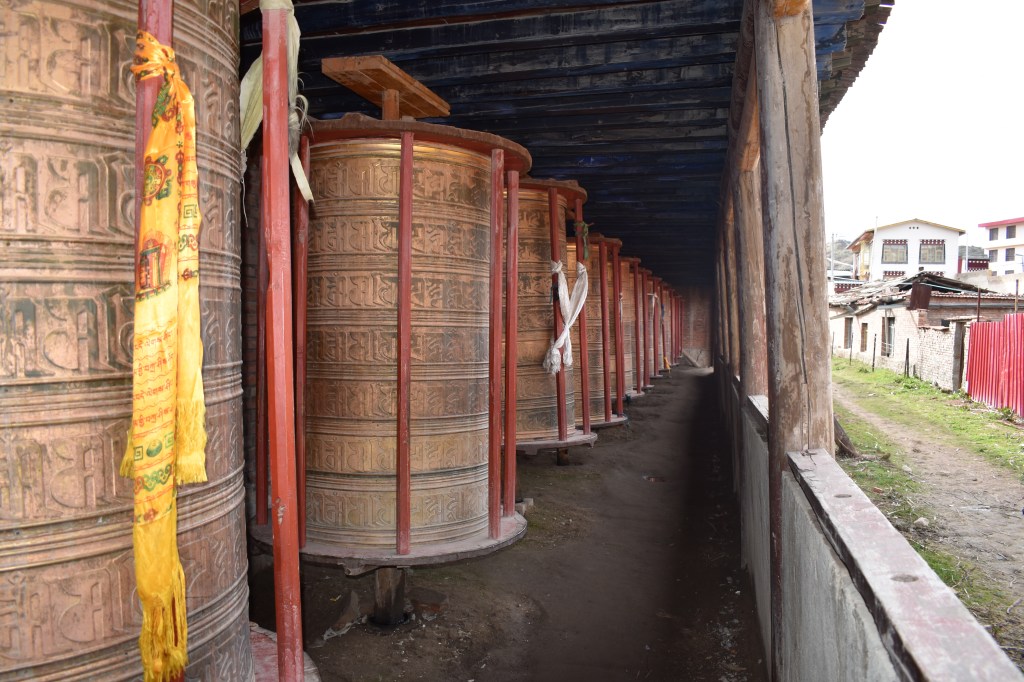
Even further into the site we meet some locals praying silently. This is done by walking along rows of prayer wheels which they spin. Inside the beautiful brass cylinders are scrolls of religious text. Through the constant use over the years, the bearings have been worn. Many have been repaired with an animal knuckle bone and grease. Simple yet effective.

Fred’s engine is a bit rough starting in the mornings. Perhaps due to the altitude or old age? So I reset the gaps on the points. In doing so I fail to make a good connection with the thin wire connecting the condenser and the coil. A basic error that stumps me. I try all kinds of things but to no avail. Ying Chu calls for a mechanic, who takes out the coil and checks it. replaces the points and checks them. eventually finding the fault between the points arm insulator and wires. all fixed and returned to normal. A lesson learnt. From now on I will check that the wires do not touch the points arm and only the center post. I have used my last set of points, so will make contact with Stuart and get him to send out some more to Ulaanbaatar. For a short while however I find that the engine is under powered and misses under load which with the hills that we encounter is a worry. Each night I do my usual checks on the points plugs and liquids and find nothing however when I check the spark strength it is low so check the polarity of the coil and find that the mechanic has reversed the polarity producing at least 20% less spark than required. Easy fix but frustrating…..
12th May Lanzhou (Via Labrang).
Today we detour to a very large monastery at Labrang. This is one of the largest monasteries of this sect in China. It is the home to 1500 monks. As with the monastery in Langmusi the monks accommodation is basic. Made up of simple stone blocks each with an elaborate solid carved wooden door with old rusted handles and hinges.

We are not allowed to photograph or video the monks at prayer in the large chanting halls, but witness them gathering and hear their chants and incantations.
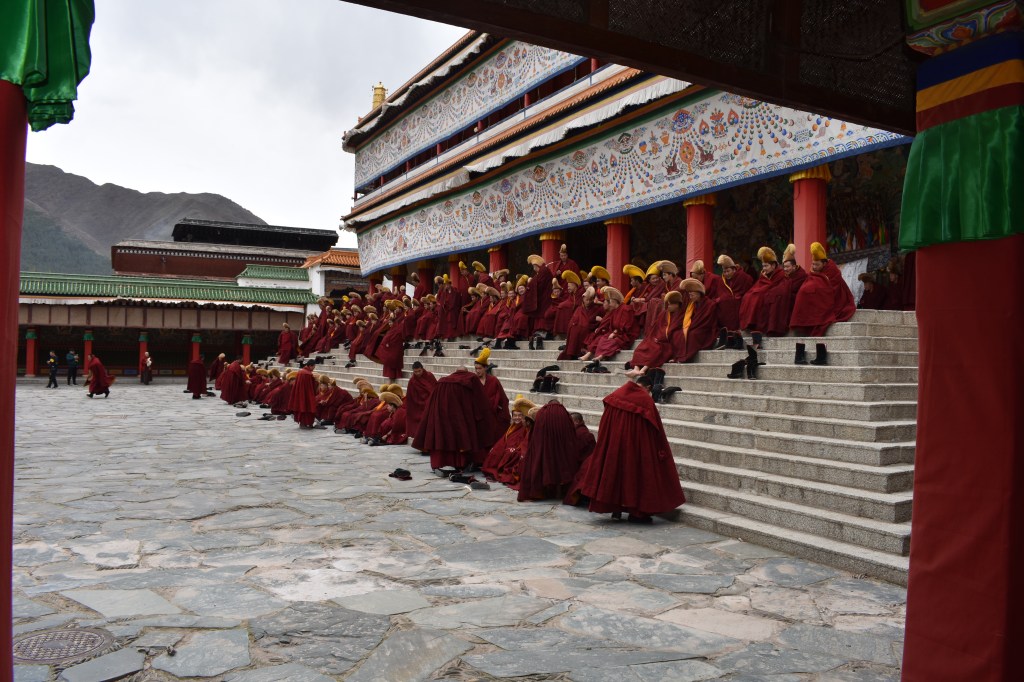
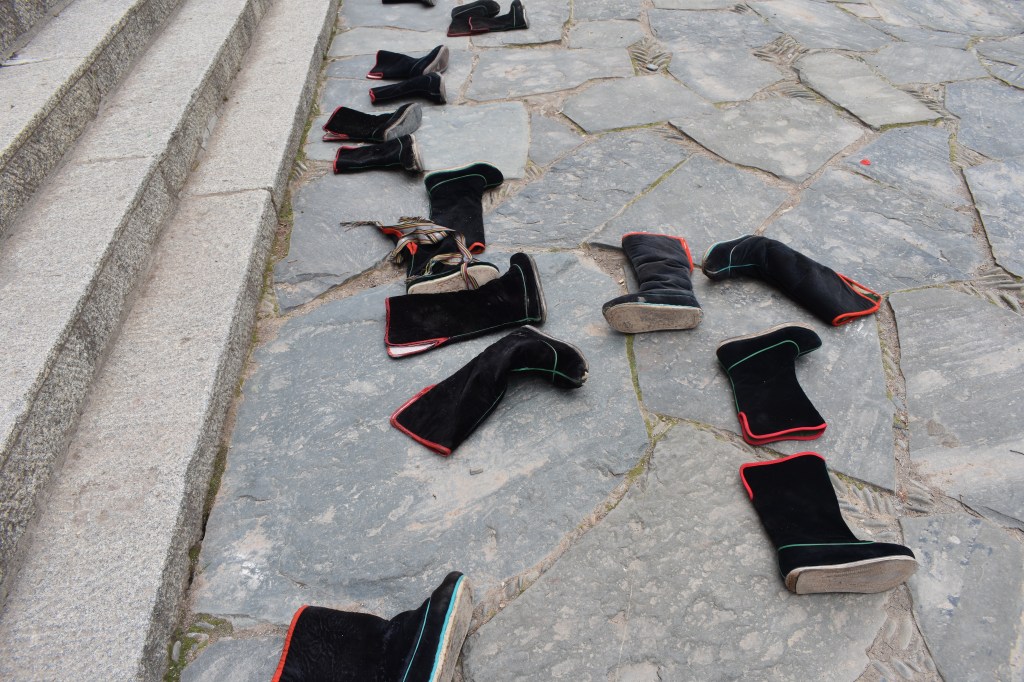
The halls are the most brilliant and splendid buildings. Outside we find many people (not monks) walking the perimeter of the building each carrying a prayer wheel that is spun as they recite prayers. every three paces the pilgrims stop and lie prone on the floor. inside the building the are the most elaborate and spiritual places. Full of small statues of Buddha. The walls and columns are adorned with bright cloths, velvet, ribbons and banners. There is a smell of pungent burning. At the entrance of each hall is a fire a clay and brick oven like structure where pilgrims and monks can burn offerings of branches, seeds, beans and other foods. We are aware of another smell that is familiar but very foreign too. it is the burning of Yak butter candles. These candles consist of small brass cups into which Yak butter and lard is rendered down and poured into the cups with a wick that burns slowly.
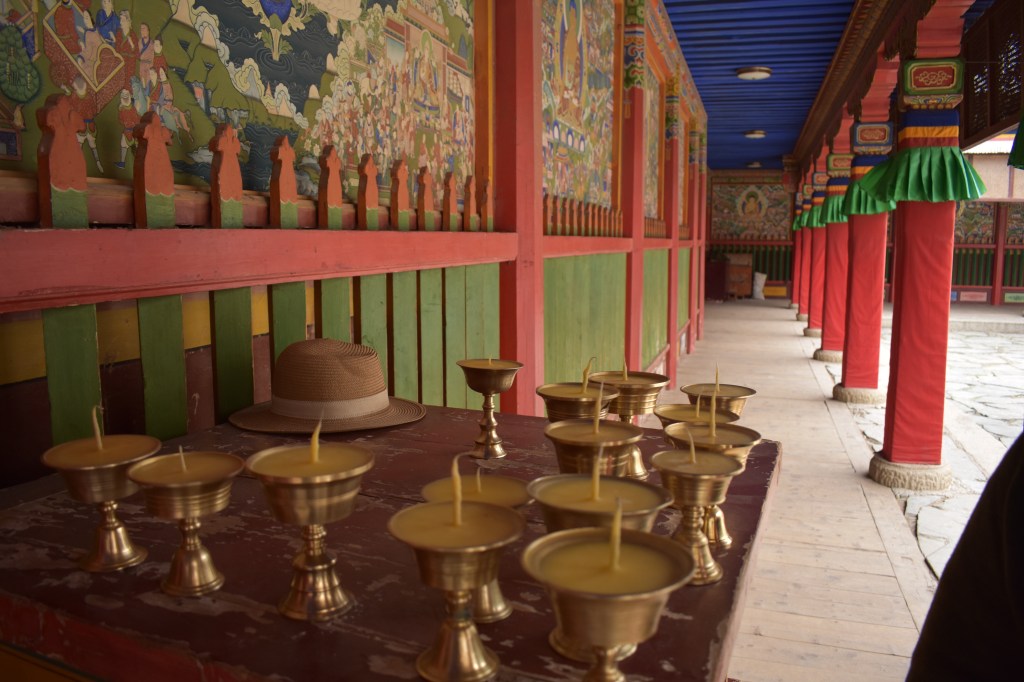
Every where is so very peaceful and serene. the silence is broken occasionally by chanting, a gong or bells. We even hear from some of the monks who have trained in the art, the throat singing that we expected the hear in Mongolia not China. The pathways between each of the accommodation blocks and the halls are rough and muddy, or rough stone cobble paving.
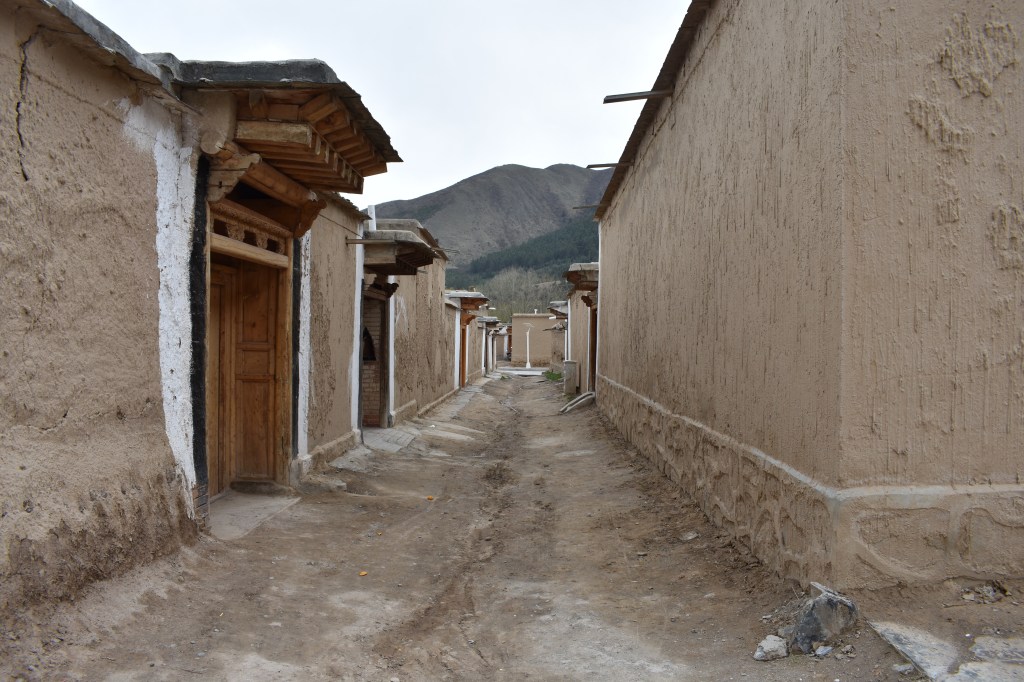
Lower down nearer the town the path is paved with neat paving stones. Many of the boys greet us with huge smiles and a confident “hello how are you?” or “Ni hao” (hello in Chinese). our response has now become quite natural. “Ni Hao, fine thank you”. Being enveloped by quiet and calm, like a comforting cloak, we are reminded that being mindful and introspective is a wonderful thing.
On to Lanzhou. The road is a ‘National’ road however this time it is good quality leading us to the main ‘expressway’ which is as usual tolled and an excellent drive. The road is not as busy as we have seen them. However the animals either along the way or crossing are numerous. we are forced to stop for yak, sheep, and pigs. Small black pigs who decide that when we are passing it would be a great idea to walk or run across the road. its almost as if they have right of way and they will exercise that right! At one point we come to a halt for two large Marmot fighting in the middle of the road totally oblivious of the large aluminium machine heading their way.

There are 15 species of Marmot in Asia, Europe and North America. They are a large rodent about the size of a very large cat, a fat squirrel like animal, that grazes on the plains and hillsides. we will find that we see more of these animals along the way. Getting steadily different in colour as we head North and then as we head west towards Europe in a month or so.
The food in China we have discovered is amazing and very healthy and simple. It arrives at you table hot and quickly in about five minutes from ordering. this is due to the fresh and simple way it is prepared and cooked. each night so far we have had a couple of dishes between us. a meat, fish and vegetable dish and a rice. The vegetable dish is fresh bok choy, or mushrooms and often black beans of something similar. Or lotus fruit, a tuber with a crunchy texture. Each dish is small but very filling and very tasty. The trick we think is to cook very quickly and over a VERY HIGH HEAT. This doesn’t allow the veg to wilt or loose its colour and structure. All dishes have background flavours of garlic, chilies (lots of the them) black beans and spring onions etc. You will find no dairy or sugar in the their diet hence very few fat or obese Chinese. The latter you will find in the main cities where the poor western diet has infiltrated their society. Mainly I suspect the more wealthy people who can afford the western food, or eating out a lot.
13th May Binxi.
I have mentioned the roads in China many times before, but unless you’ve actually driven on them you cannot imagine the conditions both good and awful. China has 1.4 Billion people populating its domestic land. that is 18.5% of the worlds population. Staggering when you you stop and think about it. We in the west view China historically as a Communist state with the majority of the people being poor, and under the tyranny and control of the few state officers. We have found along the way here that the technology is simple yet effective. Agriculture is unbelievable. Ordered and productive. the people are very friendly and inquisitive. Whilst there are still undertones of Communist order, there is a sense of community and productivity. Granted we have a guide who is showing us what the countries government wants us to see, and the route never takes us near the poverty and industrial ruin the we imagine. We have seen no factories or large industrial areas. But we have seen whole cities deserted and ready to be occupied when a city gets too big. at some point the inhabitants are told to pack up and move to the new city and start again. Something unimaginable here in New Zealand. The roads are as mentioned either ‘expressways’ that are tolled, ‘National’ roads that are in mixed repair. and tracks in remote areas. I can however tell you that the Chinese are the worst drivers I have ever seen. On the open road they drive fast and all over the place. The bus drivers are rude and dangerous. Even when in the inside lane and no one around the Buses come up behind you and blast their horn “EVERY TIME”! I should be used to it, but It scares the hell out of me each time. They also drive up beside you and sit there, thus preventing you from moving and passing a slow truck or gaining speed up a hill. In the cities they are all over the place. Lane rules and habit is non existent. I remember saying out loud to Julia and Ying Chu, ” I’m a guru at this”! what I meant was that I knew that they would not hit me if I stayed in the line of attack and went where I needed to go. They generally stayed out of my way. I guess we were a fairly large military vehicle that they had to avoid. I still hated much of the driving in this country. If it wasn’t the drivers it was the state of the roads. The National roads are full of pot holes and are commanded by the large trucks who own the entire road. You have to be very wary when you see one and expect one on your side of the road at every corner. With the hills being quite high in altitude and the weather in winter cold, they get a hammering. The seal is littered with holes and in the heat melting in spots. Each truck has a system to cool the brakes that are required to slow decent and at corners. Water is dripped on to the brake to cool it. This means that the surface of the road in areas of high use is wet. Apparently in the winter this then freezes causing many accidents. The Expressways are fantastic and well maintained. In most places around the world, roads follow the contour of the hills and mountains in tracks cut in to the side of the hill. China however, much like a 1950’s to 70’s cartoon the road sits on an elevated platform sitting in stilts that seem to hover in mid air high up the sides of the mountains and hills. gangs of people can be seen with primitive brush brooms sweeping its entire length. I suppose providing employment for a few. You are quite high up and so the views are stunning. The platforms have safety sides that allow a sense of security from the immense drop below. At various places there are rest areas where free boiling water is provided to make tea or simple meals.
Today we are on the Expressway. A good pace is set until a truck or car slows beside you to take photos or just gawp. Fuel is quite expensive….well just as expensive as back home. 500 Yuan buys you 70 Litres. that’s about $117nz. After the days drive we arrive in Binxi. Book in and head out for a meal. Dinner over looks the town and the hillside that is covered in a multitude of lights.
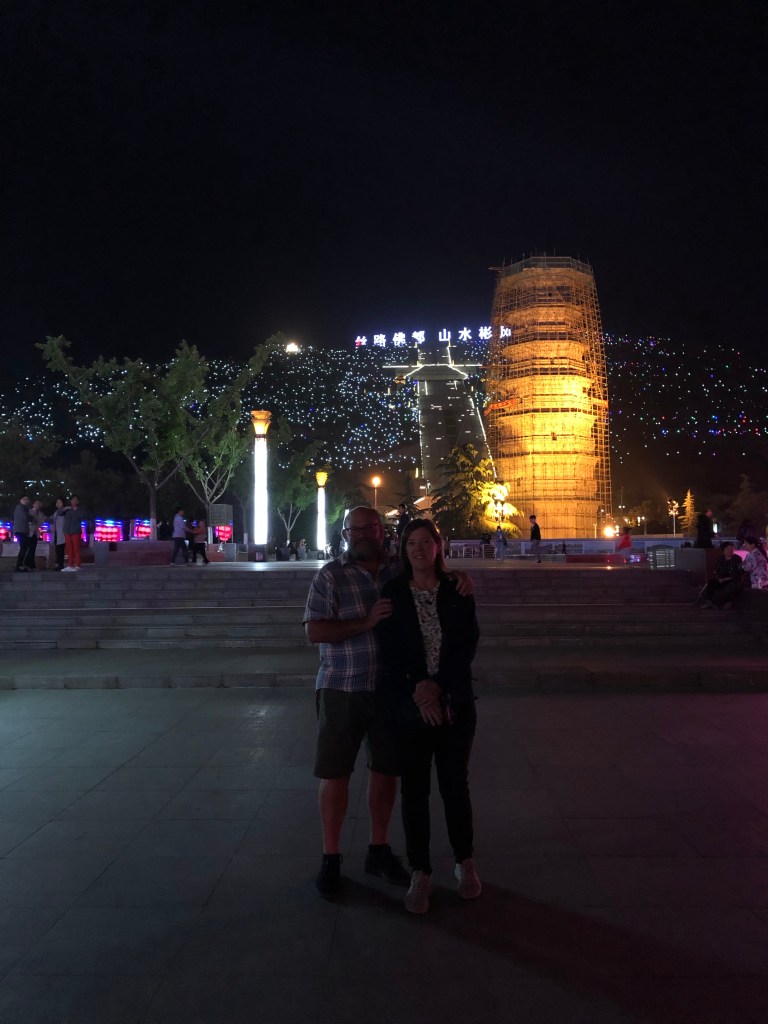
The steps and even the ancient pagoda is lit up. From where we are we can see the community out enjoying the evening. Despite the sandstorm that has enveloped much of the province, they are all out in the peoples parks. Dancing in groups as they are in many cities each night. Its amazing to think that some make the effort to come out each day to dance in groups like ‘aerobics’ in public. Some are singing Karaoke, or as in other areas playing ancient musical instruments with a old lady singing to the accompaniment. It doesn’t sound great, but they seem to be enjoying themselves.
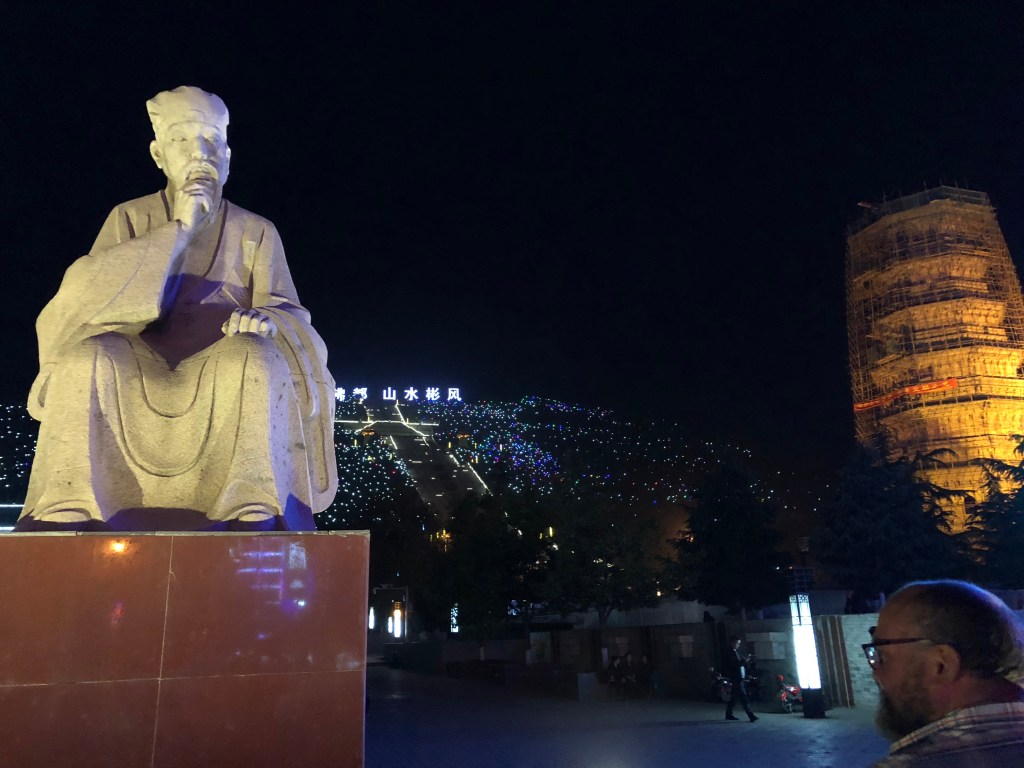
Whilst we are there Ying Chu gets a phone call from the hotel. The police have arrived and want us to leave as this particular hotel is not certified to host foreigners. She did a great job talking down the aggressive and grumpy policemen who are eventually persuaded to let us stay.
14th May Xi’an.
15th May Heijin.
https://en.wikipedia.org/wiki/Terracotta_Army
https://www.nationalgeographic.com/history/archaeology/emperor-qin/
Today is exciting…..we are visiting the Terracotta Warriors/army. I have often read about these but knew little about them or their significance. They are considered to be the 8th wonder of the world. At the site there are four main ‘pits’ or ‘vaults’. Where they were discovered in 1974 by a farmer who was digging a well for water. They are the mausoleum of The Emperor Qin Shihuang the ‘first Emperor’ and his terracotta army. Legend has it that they were first discovered earlier than 1974 by another farmer also digging a well, but the significance was not recognised due to primitive nature of the era and the finder. The story of the earlier find was told by a man who at the time of the find was 13 year old. His father dug the well and found ‘strange figures’. Whilst digging the well an arm was broken off one of the figures. Shortly after the well was completed the well dried up. Believing the the ‘strange figures’ had drunk all the water, they smashed several of the figures and buried them.
Ying Zheng was 13 when he succeeded as king of the Qin state.taking the title of Emperor Qin Shihuang (meaning ‘first Emperor’ of the Qin state) He died at the age of 51 in 210BC. the pits are fascinating. the Mausoleum and each of the soldiers are hand made by 700,000 plus craftsmen. Each one individual and full size. The armies have horse drawn chariots, carriages, musicians, archers and weaponry that is extraordinarily detailed. Along with the terracotta are other materials that make up the detail including bronze. They are lined up in pits and trenches that are covered in wooden poles to protect them. Vault I was the main force of the army. Vault II contained the multi purpose battle formations. Vault III was the Command headquarters. Vault IV is in complete. the archaeologists are discovering new items all the time. The find is exposing much of the quite advanced technology of the time, including a sword that appears to have been chrome plated (a technique not ‘discovered/invented’ until well into the 20thC). each figure was ornately painted and life like. The Chinese are delaying the unearthing of more of the army due to the deterioration of the colour that has faded upon contact with the air and ultraviolet light. A project is underway between a German company and the Chinese to find a way to preserve the paint and coloured details. This is literally an ‘awesome’ site, a place who’s magnificence can only be understood by seeing it for yourself.
16th May Pingyao (city of Gutao).
https://en.wikipedia.org/wiki/Pingyao
Pingyao is a city with ancient walls that prohibit cars entering. we therefore have to ask a local if we can park Fred in their yard over night. and walk to our guesthouse. The house is an old flour mill about 400 years old. down an alley and through archways to our room. A small very old wooden door covered by a screen can unlocked by a primitive sliding latch and opened to room with a stone floor and bed that is raised up off the floor made from bricks. The mattress and covers are thin, however we are by now used to hard beds! Under the bed is a cavity that in the old days a fire was lit to heat not just the room but more importantly the bed. Simple solutions to improve comfort. The streets are cobbled, but with large smooth cobbles, buildings are traditional and old style. Pingyao was once the capital of the province and famous for vinegar, Baijiu rice liquor,(https://en.wikipedia.org/wiki/Baijiu) and beef. At night the streets are beautifully lit up with paper Chinese lanterns and lights. here we bought a few supplies for the Mongolian leg where we believe provisions may be scarce? Its a very restful place giving us time to explore and relax.
17th May Datong.
https://www.chinahighlights.com/greatwall/fact/
https://en.wikipedia.org/wiki/Great_Wall_of_China
Today is a long drive all the way up to Datong where we will prep for leaving China and entering Mongolia. We stop about 100kms south of today’s destination to see a section of ‘Great Wall of China’. I have always longed to visit this engineering feat. As I get closer to the wall I learn that it is fact a series of walls built at various dates over a period of more than 2000 years as early as the C7th BC,and is constructed from a variety of materials. the wall we are shown and see as westerners is in fact a rebuilt section started in 1957. Obviously due to the mountainous terrain and vast history the sections are often in precarious and out of reach places. its purpose was to protect and contain the states of the old Chinese states from the nomadic enemies and peoples of the north. As well as for protection,it was used to transport goods along the ancient ‘Silk routes’ and for communication throughout the empire. Datong is a wind swept and wet place. We need Fuel for Fred, gas for our cooker and food and supplies for the trip north. We get no joy in finding gas and spend a few hour looking and asking the locals for help. The valve for the bottle, whilst made in China is the wrong size and no one can supplies a fitting attachment to fill it. Tonights meal is at a local restaurant packed with locals (lots of them! families and groups all enjoying the feast and company). its an all you can eat Smorgasbord meal where if you don’t leave anything you get 50Y back each. the food is fresh and interesting. The tables have a cooker at each seat where a broth is boiled into which you can cook the amazing variety of seafood, meat and vegetables. drinks are included in the price (although the beer is weak and a bit tasteless).
18th May Erinhot.
Its still wet and windy a change from the heat that we experienced in the southern regions of China over two weeks ago. The scenery is much more barren and dessert like. Fred is spluttering and stalling due to I think the dampness, along with the need to change out the points and coil, that has had a good bashing over the potholes. We have food, fuel and water (delivered in large bottle by moped to the car and decanted into our water Jerries)
19th May Leaving China at Erinhot and entering ‘The Great Mongolian Empire‘.
Today is our last day in China. We have been pleasantly surprised by our visit here, with stunning countryside and bustling cities and towns, ancient history and culture to experience and explore. Healthy and varied diets consisting of produce raised and grown on almost every spare piece of land available. Yingchu has done a Stirling job guiding us and ensuring we have somewhere to stay and interesting places to visit and see. Its a place that clearly has come along way in the last few decades since a sort of democracy (albeit ‘Socialist Democracy’) was established by the people in the late 80’s. But its is clear that the Chinese are a nation of controlled and oppressed people, who live simple yet spiritual and community driven lives. A surveillance state still controlled by the Communist party, but still a place I would gladly visit again.

 Cleary Overland